The Iron Gates gorge (Romanian: Porțile de Fier; Serbian:Đerdapska klisura) is a natural border between Serbia and Romania the moment the Danube River enters Romania, to the city of Orsova, for approximately 150 km.

Danube River, the second longest river in Europe, has always played a vital role for several countries. Its banks, lined with castles and fortresses, formed the natural barrier between great empires, and its waters served as a vital commercial highway between nations. After flowing for almost 3,000 km through 10 countries, Danube River flows into the Black Sea in Romania, through 3 main distributaries that form the Danube Delta.
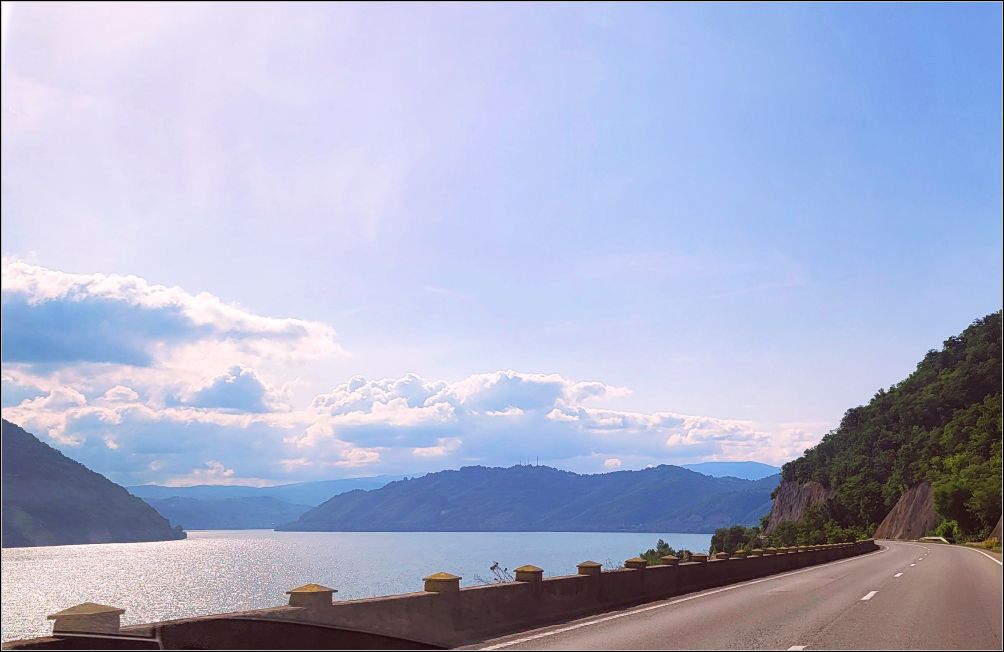
From the moment the Danube River reaches Romanian soil, it seems as if the water has found a new way. The river’s winding path has cut deep into the mountains with all its mighty power, creating several narrow sections, each of which is known as a different gorge. And all of them together form one of the most beautiful gorges in Europe, the Iron Gates. The most famous section is the Danube’s Big Boilers, where the narrowest section is located, with a width of about 150 m and a depth of up to 75 m.
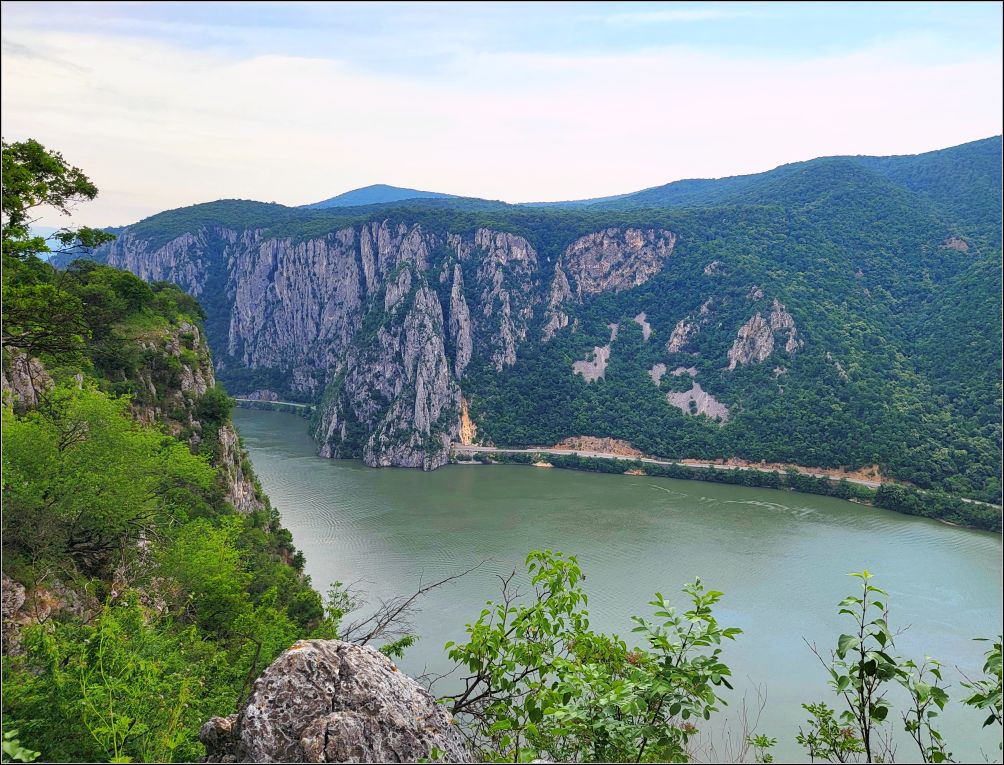
The riverbed rocks, the strong currents, the shoals, and the whirlpools have made this section of the river an infamous passage for maritime transport. Today, after centuries of developments, such as navigable channels, artificial lakes, and two dams (along with two hydroelectric power stations), traffic has been made possible much easier.
Ciucarul Mare peak
The Big Boilers’ northern bank is a hill just over 300 metres high, offering panoramic views of the river. That’s why we chose the approximatively 5 km loop that climbs up the hill, where there are several lookout points.
The hike is rated moderate, but I found it fairly easy, with a gentle incline at the beginning. Occasionally, the irregular path changed as we had to step over trees or their roots, but what’s a good hike without a little fun. Birdsong and wildflowers kept us entertained along the way, until we reached the top.
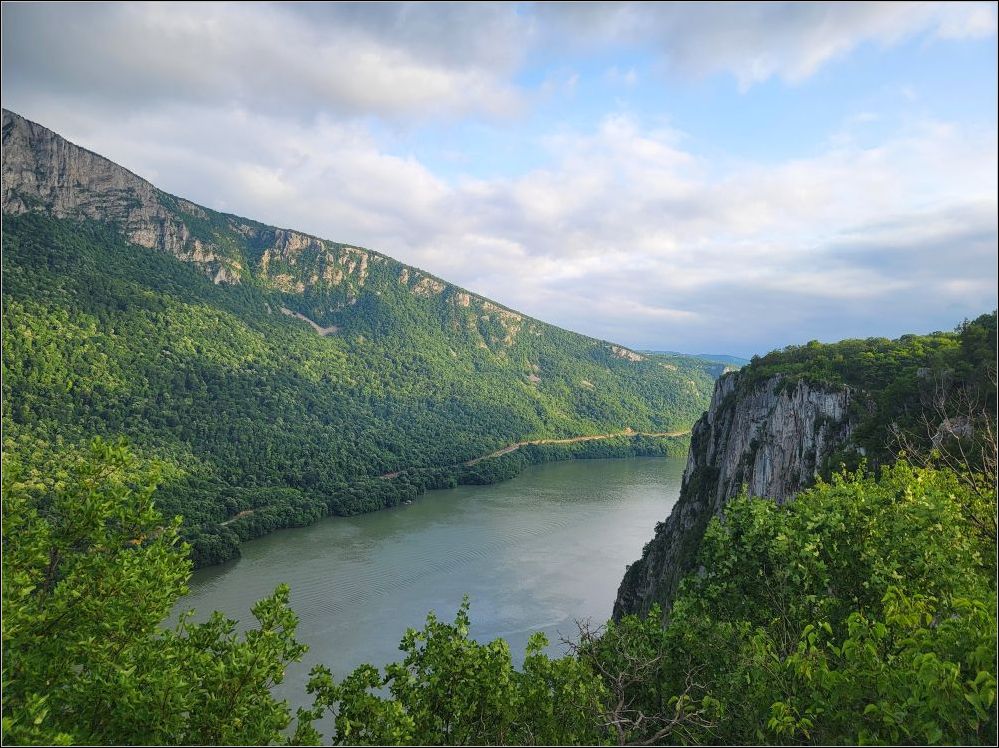
We started the hike counterclockwise, as we wanted to get to the first lookout first. There is absolutely no protection, so we had to carefully step over the boulders to the edge of the cliff, and luckily there were some sturdy rocks to rest on. If I had known there were vipers in the area, I probably wouldn’t have sat on the rocks, as snakes tend to bask under the sun, but luckily nothing happened.
Soon we continued the winding trail along the high cliffs, where more vistas unfolded our eyes. Sheer drops of daring cliffs are not for the faint of heart, but they offer amazing photo opportunities. Especially those across the river, from the Serbian bank.
The path sticks to the top of the escarpment, with a few gentle ups and downs. We stopped at every viewpoint; we simply couldn’t get enough. But we had to move on, as the evening was fast approaching. After another short break while we kept mesmerizing at the evening hues, we set off back to the parking lot.

Bridge of Apollodorus ruins
A natural barrier, the river was difficult if not impossible to cross, aptly named the Iron Gates. But it was not here, amidst of the swirls and whirls where the Roman emperor Trajan decided to built his bridge (103-105 A.C.), in order to bring supplies to the troops of his ongoing expansion campaigns. It was a little further downstream, where the river slows down, near the present-day city of Drobeta Turnu Severin.

Trajan’s Bridge was also called the Bridge of Apollodorus over the Danube after its architect and engineer Apollodorus of Damascus. Although it was only functional for 165 years, it is considered to have been the longest arch bridge in total span and length (1,135m) for more than 1,000 years. The remains of the first and last pillars can still be seen on each bank of the river.

Iron Gates Region Museum
Several archeological discoveries were made along the Danube River in this area, also on the southern border in Serbia, at Lepenski Vir, one of the most important Mesolithic sites in southeastern Europe.
If you are interested in learning a bit of history from this part of Europe, you can visit the Iron Gates Region Museum in Drobeta Turnu Severin, opened since 15 May 1972.
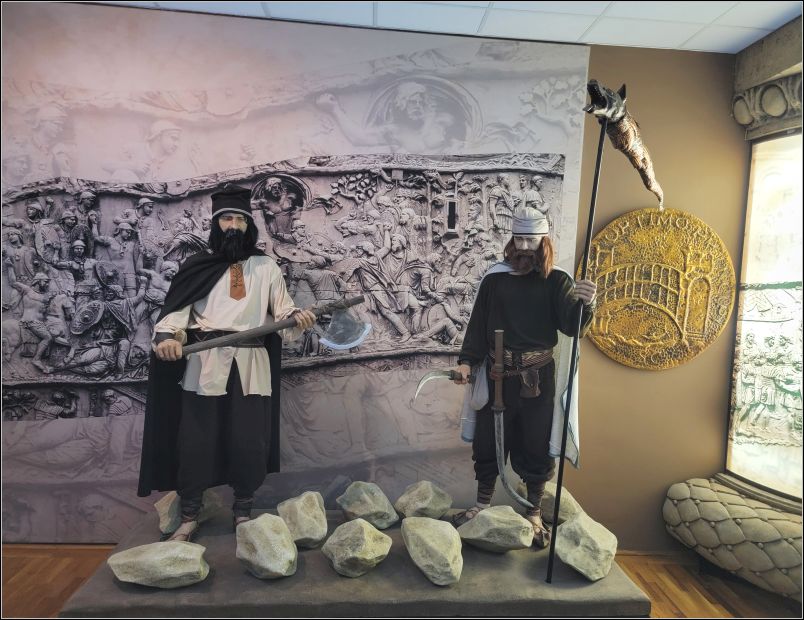
The museum’s exhibits walk visitors from the Paleolithic to the modern times, including the Roman era, when the Trajan bridge and the first rock castrum were built by the Romans on the territory of Dacia. All explanatory panels are both in Romanian and English.
Danube cruise
A visit to this area wouldn’t be complete without taking a speedboat cruise and seeing the heights of the gorge from the bottom up. Since the weather wasn’t so good, were adamant to get on a boat, as fog and light rain enveloped the entire valley. However, the drizzle stopped as we were about to leave, so we decided it wouldn’t hurt to try a short trip along the boilers.
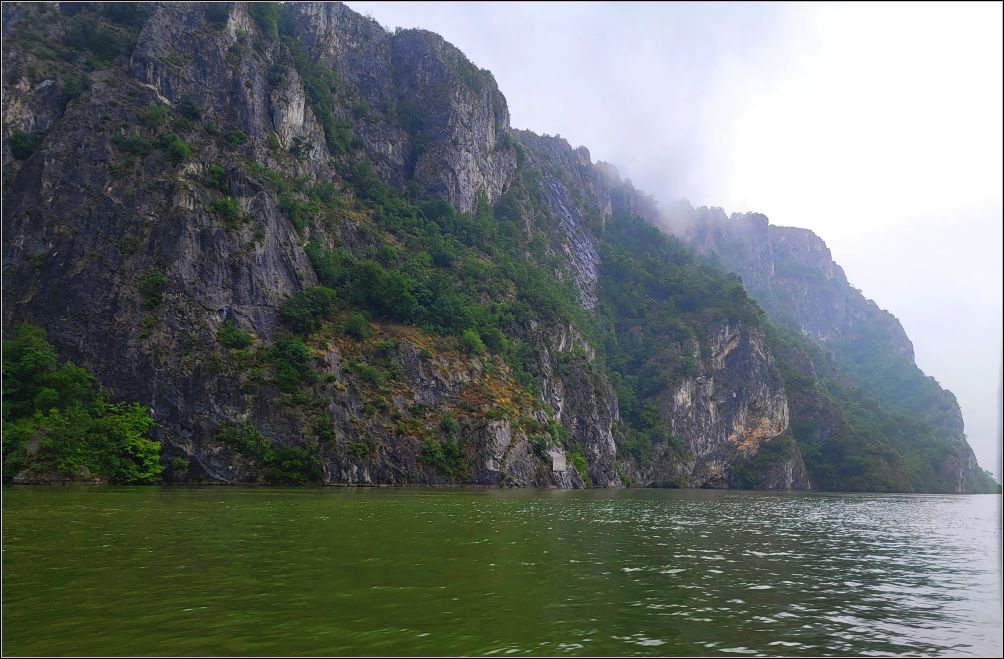
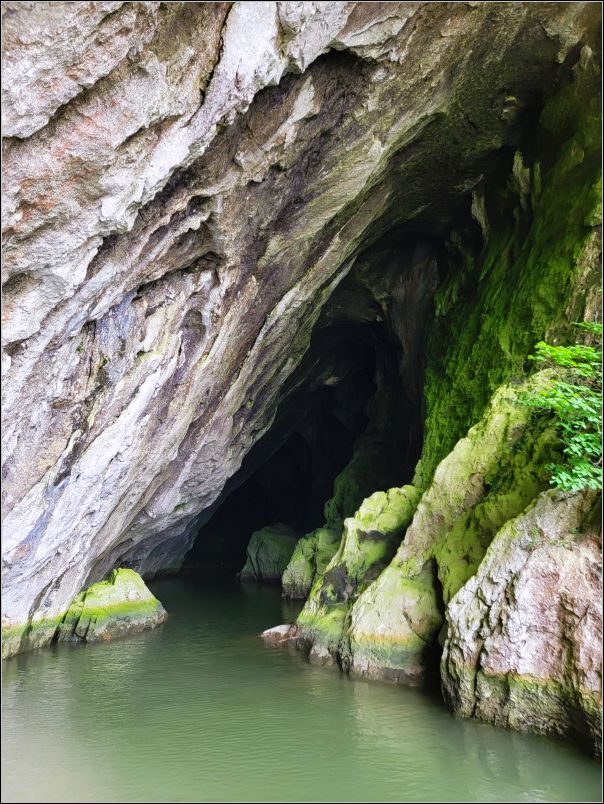
A relocated (and under renovation) Tabula Traiana still stands on the Serbian bank of the Danube, commemorating the Roman Emperor Trajan’s victory over Dacia, in 105 AD. Also, a couple of caves can be seen only from the water, but access was very limited at the time of our visit due to some landslides.
Decebalus Rex
The most prominent point of interest along the river is the statue of Decebalus (Romanian: Decebal), the last Dacian king, who fought bravely three of the wars during the expansion of the Roman Empire.
The most iconic Dacian figure, Decebalus is known as the king who unified various Dacian tribes into one nation and led them in battles and wars against the emperor Trajan after he came to power in 98. The year 101 marked the year in which Trajan’s army crossed the Danube for the first time, and the beginning of a new era of occupation of a much larger territory of the very attractive Dacia. By the year 105, Trajan’s full-scale invasion led to his most famous victory, occupying most of the Dacian territory, as depicted in stone carved bas-reliefs of Trajan’s Column still found in Rome.
Nevertheless, Decebalus remains a national hero in Romania, one of the first figures in Romanian history to fight for national freedom, and resistance to imperialism.

At 55m high and 25 m wide, Decebalus’ statue is one of the largest sculptures in stone from Europe. It was built between 1994 and 2004, and it costed over a million dollars. Facing the southern border, Decebalus remains to watch over and guard his Dacian lands, for the times to come.
~ visited in May 2024
Tip(s) of the day:
*Ciucarul Mare path is well marked with a yellow triangle, although easily to miss the trailhead from DN57;
*Keep watching the path as you walk, as there are vipers in the area. We haven’t seen anything, but the area is known for its vipers. You might choose to wear gaiters along the trail;
*Danube cruises are available from both locations of the city of Orsova, and the smaller village of Dubova from 1.5 hrs to 3-4 hours;
*Where to stay: Orsova is the closest city to the Iron Gates to find accommodation all year long, but the village of Dubova offers few nice seasonal options right by the gorge.
 1000 Places and Memories
Fantastic overview of this beautiful river. Thanks for sharing. 😊
LikeLiked by 1 person
Thank you Lynette!!
LikeLiked by 1 person
Christie, Loved reading about the incredible Danube and your experiences hiking along it from the clifftop as well as well as discovering its beauty from the water, as well. So smart of you to take advantage of both options! The statue of Decebalus was remarkable, too.
LikeLiked by 1 person
Thank you Annie, indeed we’ve had very nice panoramic views from the top of the cliffs.
Happy Friday🥰
LikeLike
Beautiful river!!
LikeLiked by 1 person
Thank you! We also enjoyed the nature while walking up the hill, everything looked so green and fresh😊
LikeLiked by 1 person
Gorgeous photos. They remind me of the Norwegian fjords, especially the Iron Gates gorge. I would like to go on a cruise on the Danube.
LikeLiked by 1 person
There are several cruising options on the Danube, we only took an evening one when we were in Budapest. Some of big boats go all the way to the end of the river, would be nice to be on one of them, isn’t it🥰
Have a great weekend!
LikeLiked by 1 person
Thank you for the information. Have a great weekend you too.
LikeLiked by 1 person
A beautiful part of the world Christie. Thanks for taking us there. Allan
LikeLiked by 1 person
Thank you for coming along🥰
Happy Friday!!
LikeLike
What a beautiful part of the Danube. There’s still so much more of Romania to see. Maggie
LikeLiked by 1 person
Indeed, there is so much more to see🥰
LikeLike
Wow…impressive! The dramatic landscape looks amazing!!
LikeLiked by 1 person
Thank you🥰
LikeLike
As I’ve never been to this part of the world, I read your wonderful post about the Danube River with great interest. With towering cliffs, narrow gorges, and rock sculptures, exploring the Iron Gates looks like a proper adventure. I am especially fascinated by the towering Decebalus statue – I can only imagine how challenging it must have been to carve it! Thanks for sharing, and have a good day 🙂 Aiva xx
LikeLiked by 1 person
Indeed, it is a fascinating statue, it took 10 years to complete for a team of twelve sculptors. It is only completed 70% from the original plan, as the financial support stopped after the commissioner and financer passed away in 2004.
Have a wonderful week ahead🥰 xx
LikeLike
Some spectacular scenery! Thanks for sharing these, Christie.
LikeLiked by 1 person
Thank you for coming along!
LikeLiked by 1 person
Fabulous captures. Looks like a beautiful and incredibly scenic hike.
LikeLiked by 1 person
We enjoyed so much our little hike, the greenery, and the views were fantastic.
Have a wonderful week ahead, and stay warm😊
LikeLiked by 1 person
Such a beautiful gorge, Christie. It sounds quite a challenging walk, though not long. Many thanks for the share.
LikeLiked by 1 person
The walk was actually quite pleasant. A short one, and more than welcomed, as we were in the car for few hours before that and we really needed a good stretch for our legs.
Happy Tuesday Jo! xx
LikeLike
You mentioned a steep drop from the path and I’m always wary of those?
LikeLiked by 1 person
Yes, that’s correct, but I never go too close to the edge😊
LikeLiked by 1 person
And there we were, four months ago, Christie. It was very impressive, as your photos show. Good job. —Curt.
LikeLiked by 1 person
I thought of you actually, when I was writing this post😊
Happy Tuesday!
LikeLike
This was a wonderful look at the Danube, Christie, from great angles. Your hike sounds challenging and impressive. This was a treat, thank you.
LikeLiked by 1 person
Glad you enjoyed the views😊
LikeLiked by 1 person
thats pretty impressive. this part of europe is overlooked too much and has much to offer the visitor
LikeLiked by 1 person
Yes, so true. Thank you for stopping by Andy, hope all is well!
LikeLike