Thunder Bay is the largest city in northwestern Ontario and was composed of two formerly separate towns: Fort William, a French fur trading outpost on the banks of the Kaministiquia River, and Port Arthur, the eastern terminus of the Canadian Pacific Railway, the major transshipment point for lakers carrying goods from across the Great Lakes.
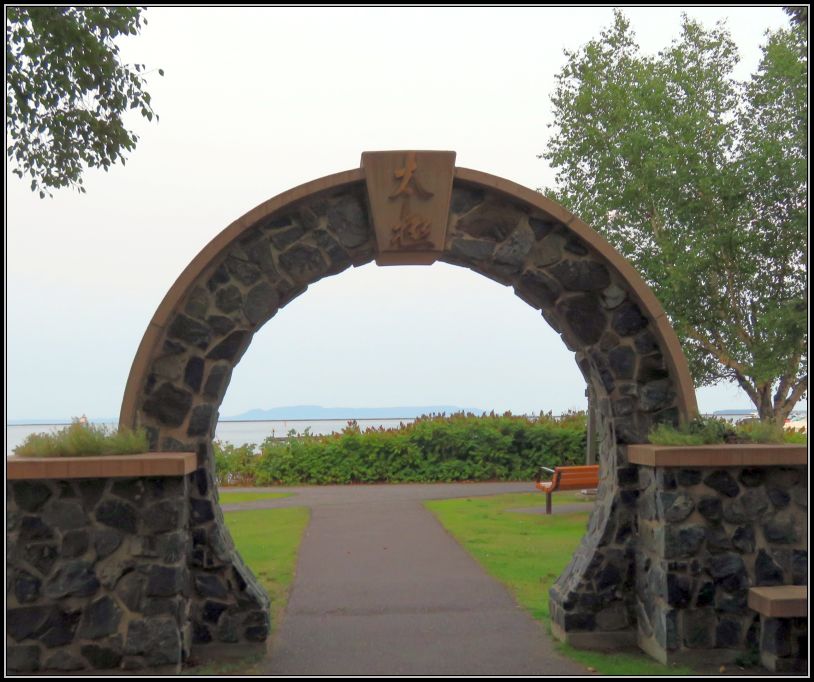
Thunder Bay centre boasts a small variety of buildings, but no one really visits this area for the city. The panoramic view of the Sleeping Giant and Marina Park are the main attractions of the Waterfront District and an afternoon spent there will give you an idea of the other activities available.
Being outdoorsy, we rather preferred to explore the surrounding area. Here are some of our favourite day trips from Thunder Bay:
High Falls on the Pigeon River
60 km south of Thunder Bay, Pigeon River Provincial Park is located no more than 100 metres from the southern border of U.S., so once you start to see the Canada Border Services Agency, you should slow down and look for the Visitor Center on your left.
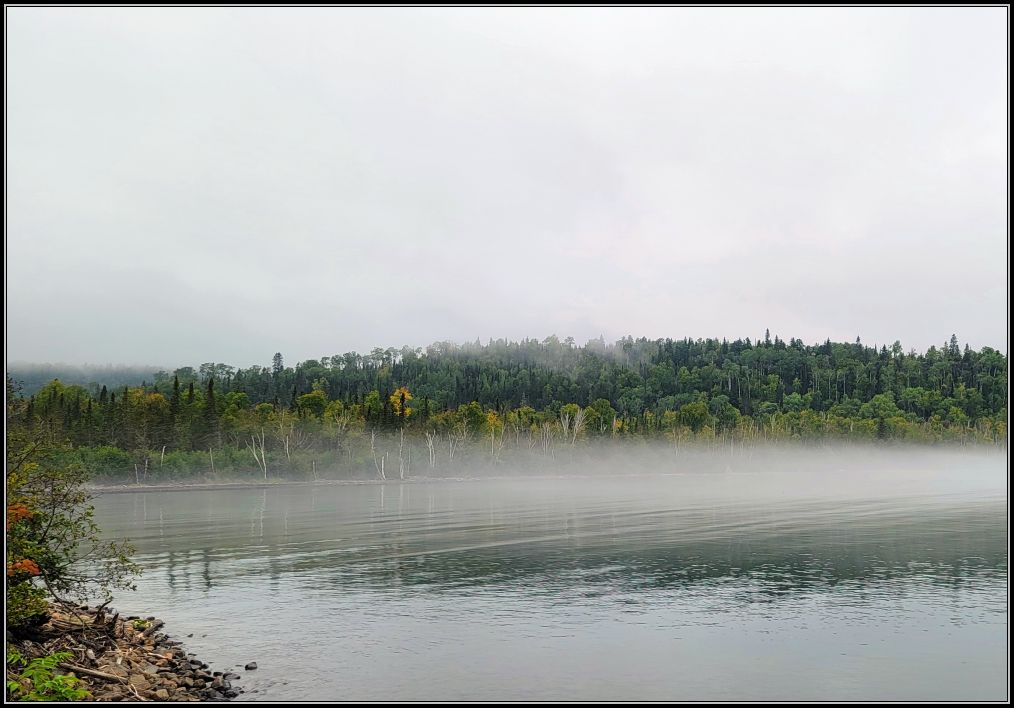
Formed by volcanic and glacial action and carved by the waters of the Pigeon River, this area is a hidden gem and a perfect example of the Canadian Shield. After reading few informative boards and checking out the trail system, we decided to walk along the boardwalk to the viewing platform on the shore of Lake Superior. The short trail wasn’t particularly spectacular, especially since the fog was enveloping the entire area. But the eerie view of Pigeon Bay caught our attention, it looked like Nessie was about to appear.
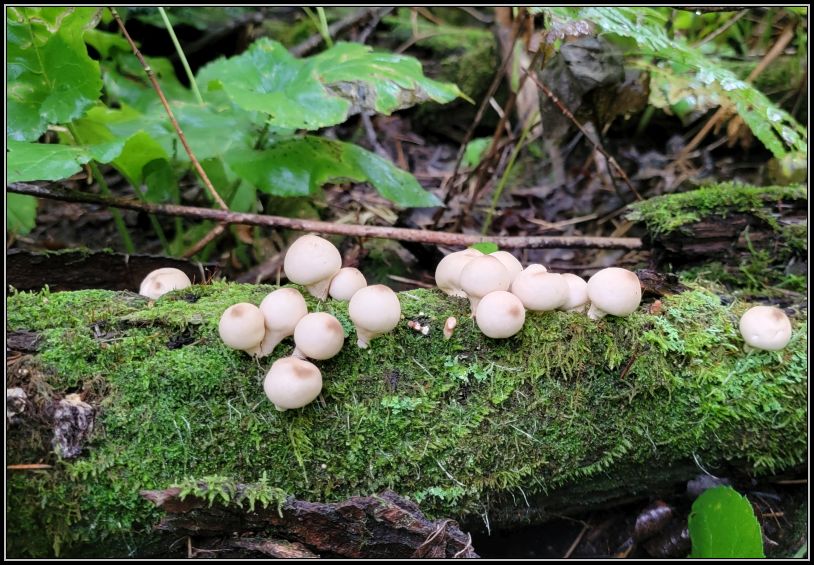
After passing through a tunnel on the other side of the road, we were eager to hit the trail to the waterfalls. The rain from the previous night had left a few puddles we had to wade through, but we enjoyed the water droplets on the leaves and the mushrooms poking their heads out into the forest.
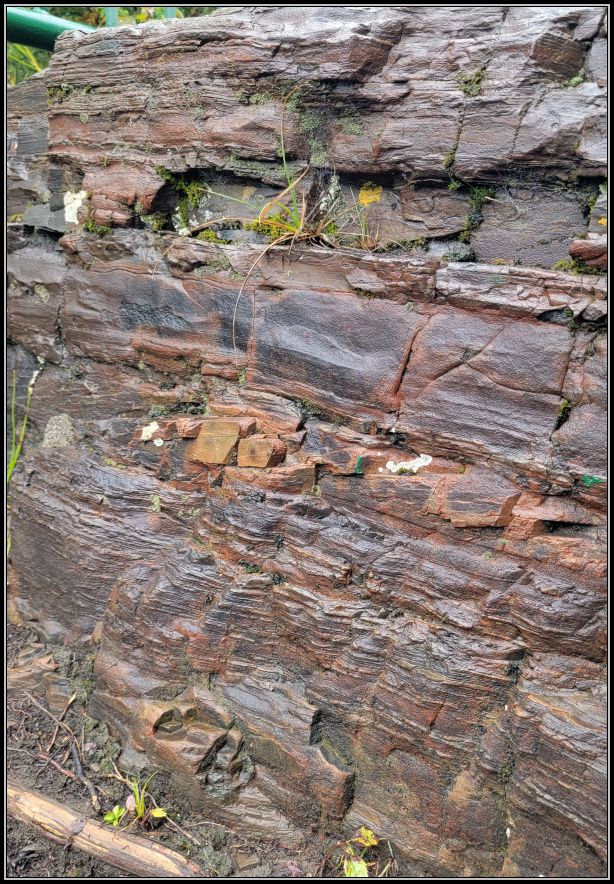
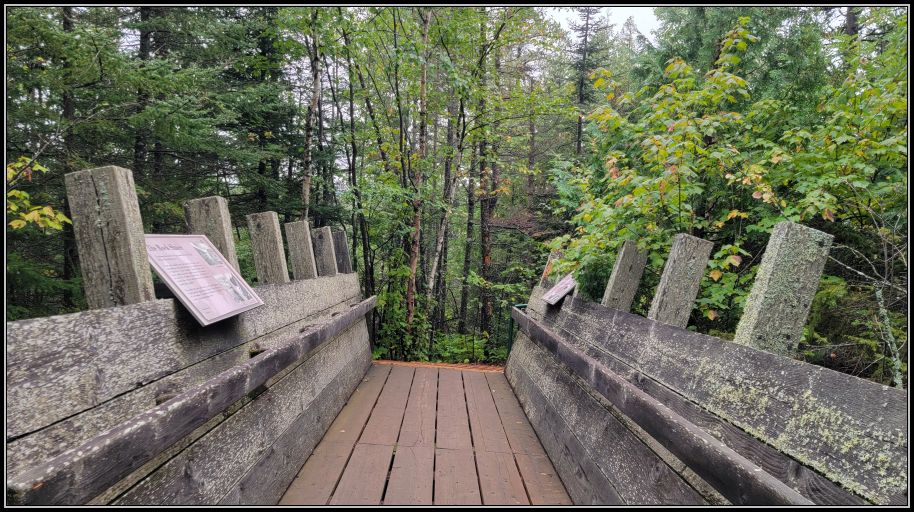
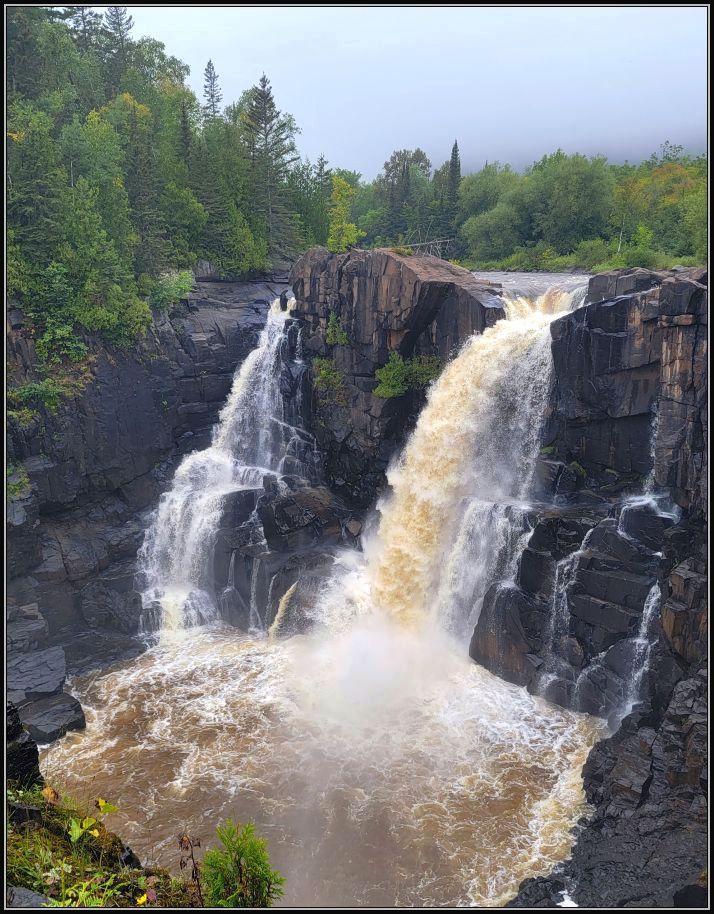
The trail is well marked and after 30 minutes of strenuous walk, we reached the platform overlooking the picturesque 28-metre-high High Halls. I find it so interesting and amusing how many waterfalls have been named High Falls throughout Ontario, but that’s another story! The interpretive signs tell a little bit about the logging era and the challenge of getting the logs around High Falls.
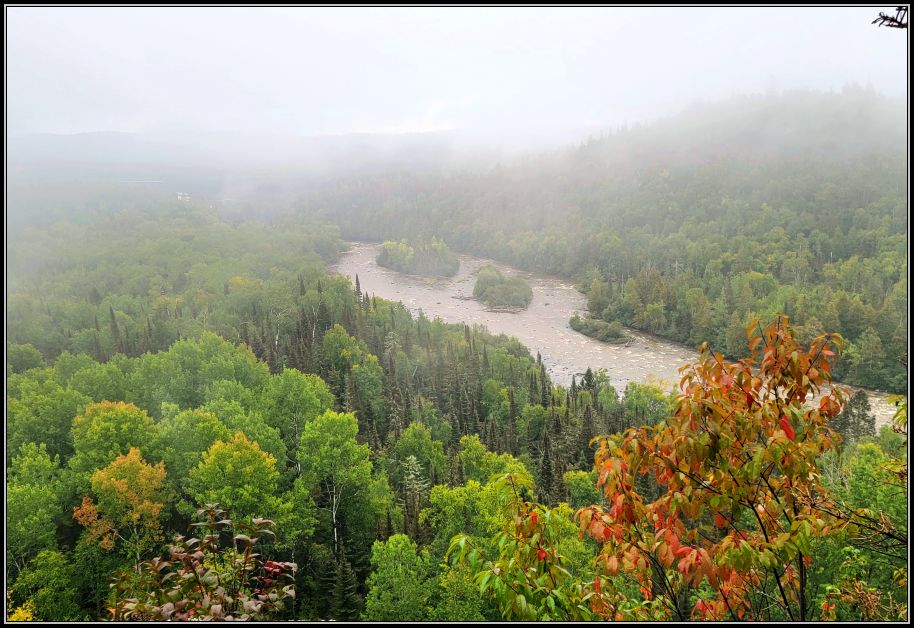
We decided to venture further to the Lookout. A slightly more difficult trail, the path took us up and down through a mixed forest and after 35 minutes we reached the lookout point. The foliage was starting to change colours, allowing us to enjoy the view, despite the mist that enveloped the entire valley.
***
Ouimet Canyon
Ouimet Canyon is one of a series of rock formations that define the character of Dorion’s fascinating “canyon country”. Rugged mountain landscapes surround the rich farm lands of region Dorion, about an hour northeast of Thunder Bay.
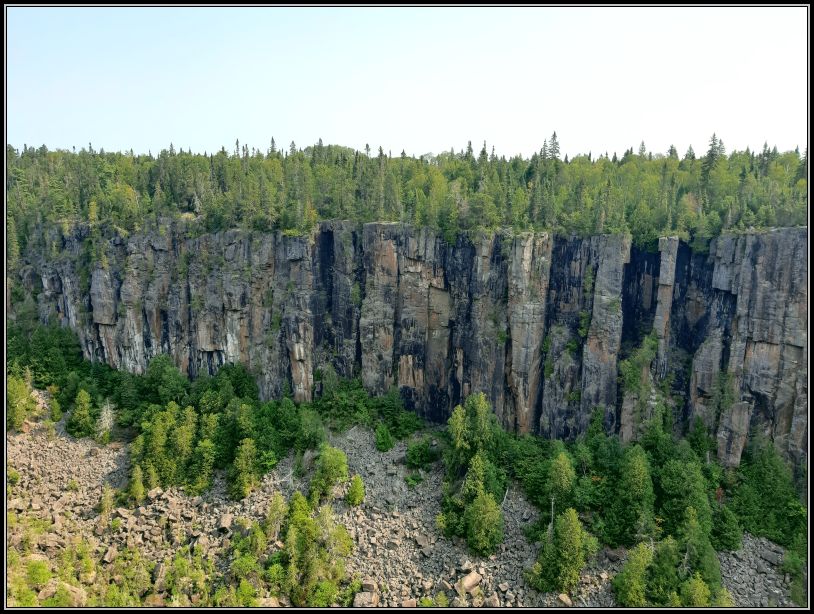
A short walk (2 km the entire loop) from the parking lot took us to a couple of viewing platforms where we could see the steep cliffs and the bottom of the canyon. The gorge is 100 metres deep, 150 metres wide and 2,000 metres long and it is part of Ouimet Canyon Provincial Park.
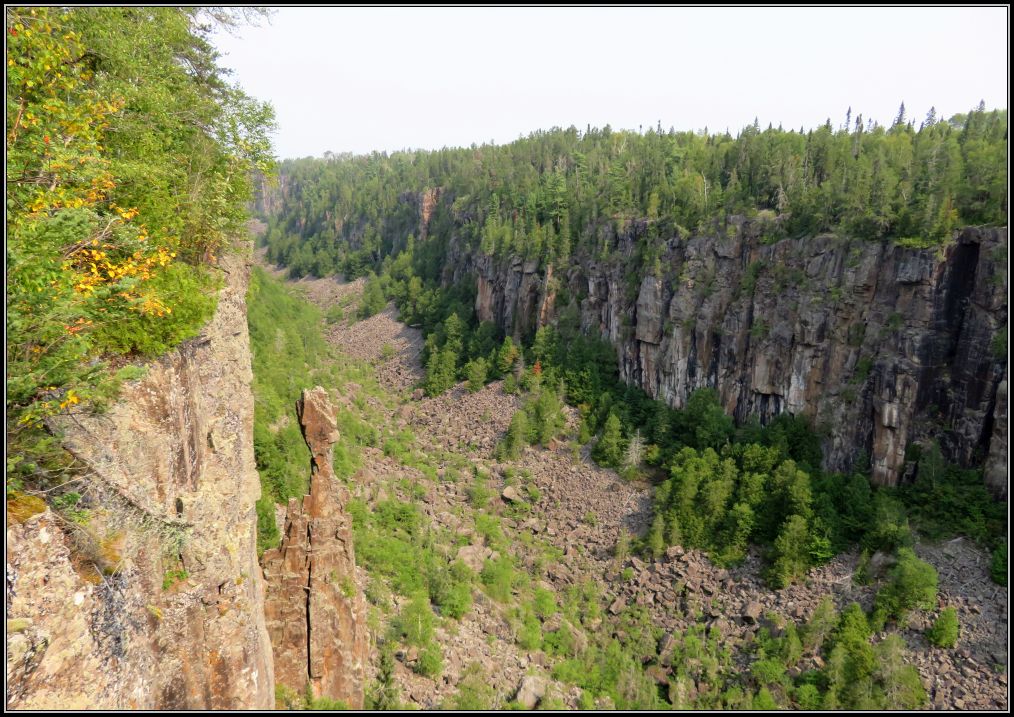
There are a couple of theories about the canyon’s formation, either during the height of the last glacial period, or somewhat later, when the glaciers slowly melted away. But the most interesting thing about the canyon is the vegetation. From the boreal or northern forest that thrives on the canyon’s rim, to the subarctic tundra found on the canyon floor, you can see plants growing here that normally grow 1,000 kilometres north. The high walls and narrow crevices offer plenty of shade and coolness to the lower slopes and floor. Blankets of tiny mosses, lichens and liverworts thrive in the moist, cooler climate and insulate the canyon floor. Beneath the moss, the ice that forms during the winter time, seldom melts.
A large rock column standing out from the sheer cliffs is known as the Indian Head and can be seen from the northern platform. The legend says that long time ago, in the days of giants, Omett was one who helped Nanabijou, a great spirit of the Ojibway people, to raise mountains and create new lakes.
Omett fell in love with Nanabijou’s daughter, Naiomi. One day, Omett was moving mountains when a piece broke off and fell on Naiomi, killing her. Afraid of Nanabijou’s anger, Omett hid her body in a shallow lake and covered it with a rock shield. Searching for Naiomi, Nanabijou walked over the shield and felt vibrations from beneath the rocks. He reached up to the sky and grabbed a large thunder bolt and drove it into the ground. The rock split open, and in the wide canyon he discovered Naiomi’s body.
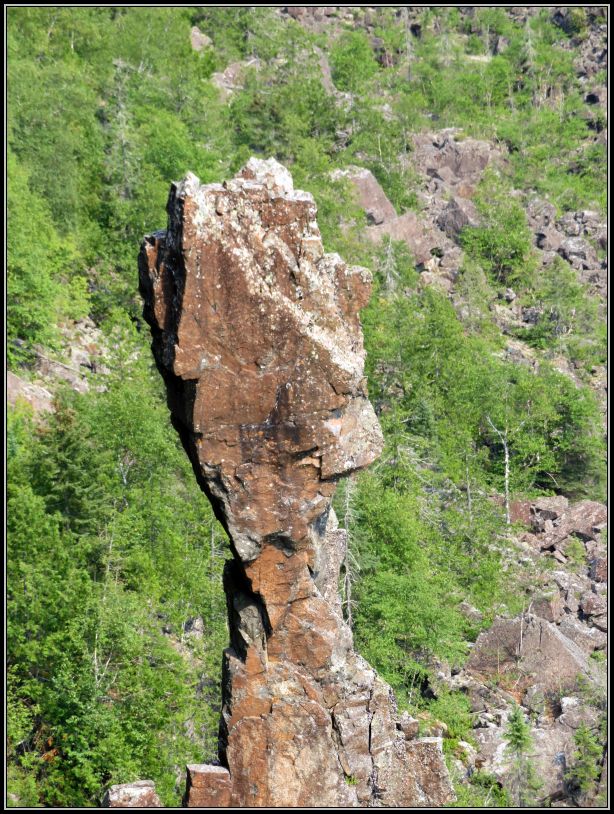
Nanabijou buried Naiomi at the bottom of the canyon, and from her grave grew rare and beautiful flowers. To punish Omett, Nanabijou turned him into stone and placed him on the canyon wall to guard her grave, forever.
***
Eagle Canyon
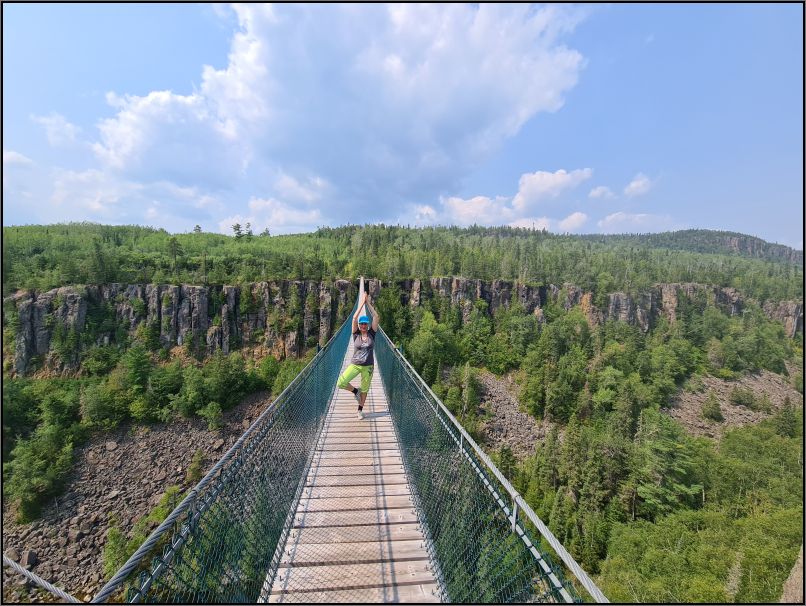
Located 80 km Northeast from Thunder Bay, Eagle Canyon Adventures, a privately owned park, is home to Canada’s longest foot suspension bridge, at 600 feet (183 m) long and 152 feet (46 m) high. If one bridge isn’t enough for you, there is a second bridge which spans 300 feet across the canyon and 125 feet above the ground. The park is open seasonally and offers campgrounds, ziplining, few trails, picnic areas, and endless scenic views.

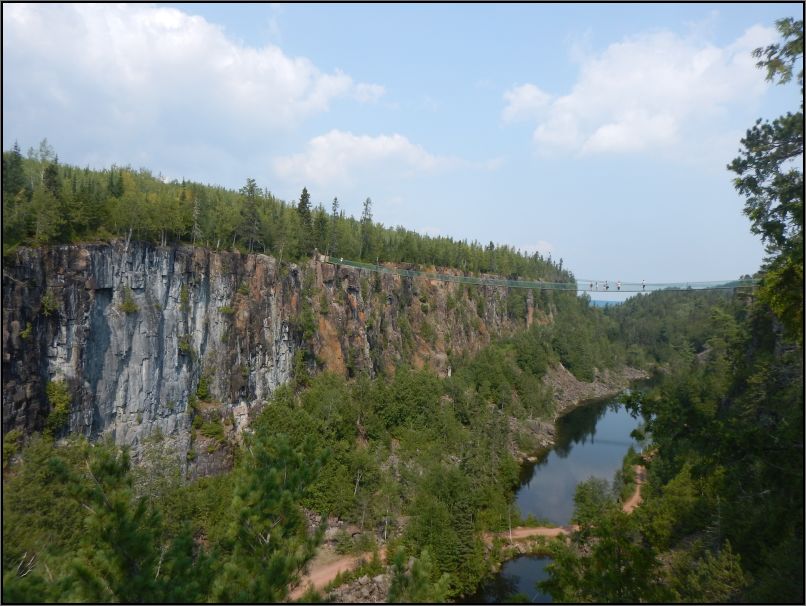
You need at least a couple of hours to get around and enjoy the scenery. The 2 km trail that starts from the parking lot is a loop trail, and we chose to walk to the shortest bridge first. After getting over my first pang of fear, we soon reached the second bridge, the longest one.

There are some other wilderness trails in the park, as well as the one that descends down into the canyon via stairs. My legs were shaking enough after the amazing experience of crossing both bridges, so we didn’t venture any further.
If you are afraid of heights, then walking at 46 metres above the canyon floor might not be for you. But I managed to overcome my fear, the people were so nice, giving me space, and walking slowly, a step at a time was the solution. Or else, you can wait until everyone else has left and then you can have the entire bridge for yourself!
***
Kakabeka Waterfalls
Ontario doesn’t have high elevations (no more than 700 m), but the rugged landscape across the province makes the perfect setting for a variety of waterfalls, which we love to watch. It’s one of the many reasons we love Northern Ontario.
This year we managed to get to Kakabeka Falls again. Nicknamed “the Niagara of the North”, Kakabeka Falls is the second-highest waterfall in Ontario, at 40 metres high. The powerful waters rush into several cascades before reaching the gorge, where they calm down. There is a large platform right next to the main parking lot where you can admire the view. Then, a short wooden path will take you to another platform where you can see the gorge.
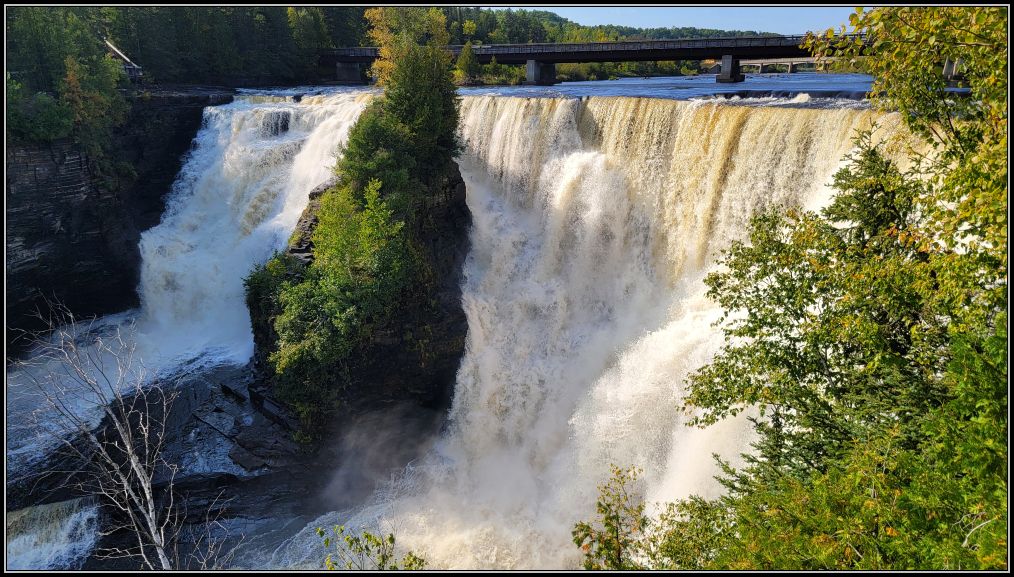
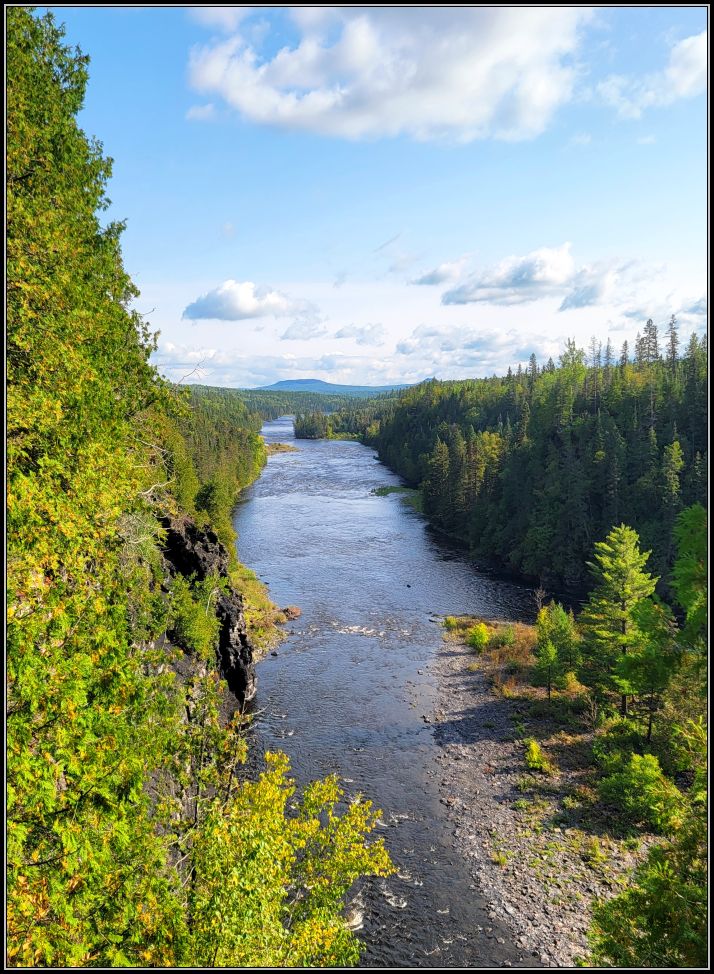
The rocky walls of the gorge and the escarpment along them are composed mainly of unstable, eroded shale, hence access to the gorge below is not allowed. But we crossed the bridge and got to another observation platform, from where we could see the falls from a different angle.
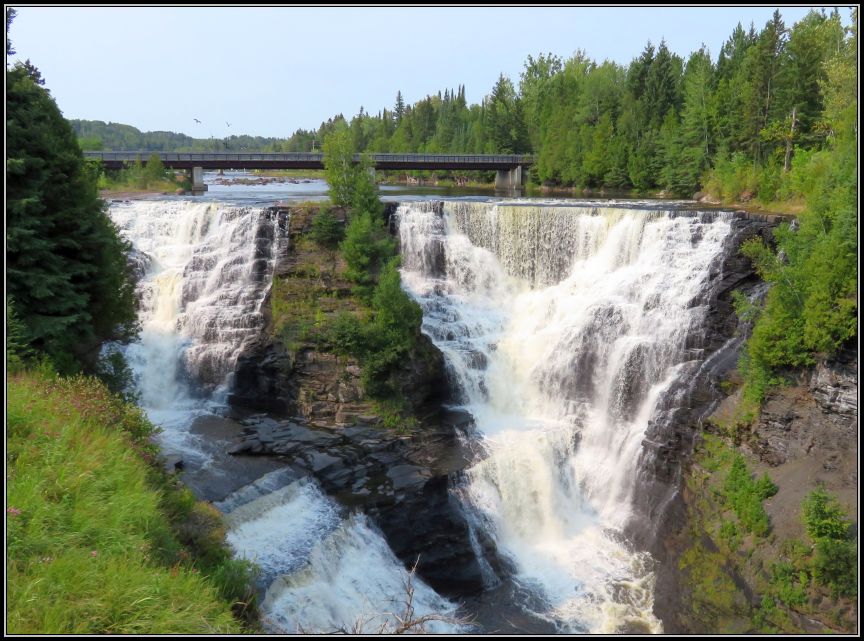
There are six hiking trails in Kakabeka Falls Provincial Park that extend along the Kaministiquia River. Several panels explain the history of this place and its importance, as the river was used as a major route by voyageurs, the French-Canadian people hired to transport furs by canoe during the peak of the North American fur trade (18th-19th century).
***
Fort William
Trade started back in 1000 AD in North America, in Newfoundland, but continued later when French explorers met Algonquins, Iroquois, and Hurons. French settlements such as Fort William slowly advanced into North America, building a trading relationship with fur trappers. Formed officially in 1784, the NorthWest Company was comprised of a loose coalition of independent traders based in Montreal, who later challenged the Hudson Bay Company for domination of the fur trade in North America. Various goods, like blankets, pots and pans, knives, axes, traps, were loaded from the Eastern warehouses (mainly from Montreal), into their canoes, and carried into the wilderness, searching for the precious beaver pelts. Meanwhile the interest for luxury furs such arctic fox, silver fox, or minks emerged soon after, and Fort William became a rendezvous place for Montreal merchants and the voyageurs, the French-Canadian people hired to transport trade goods and furs. They were strong people, used to paddle for 14 to 16 hours a day while singing to keep up the rhythm and to carry heavy stuff on their backs during a portage. They were under 3 to 5 years contract and usually wintered at Fort Williams, since this was the midpoint between the Lake Athabasca and Montreal, thus an important transshipment depot in the inland Canada.
Fort William was just a trading post, a base of what would become Canada. At the annual rendezvous at the Fort, the Eastern voyageurs coming from Montreal (called “pork eaters”) would meet with those who spent the winter in the Northwest (called “winterers”) who would exchange their cargoes, returning to their point of departure. Fort William is one of the greatest living history attractions in North America and offers a vivid image of the fur trade life.
***
Few more places in Thunder Bay area worth mentioning are: Mission Marsh Conservation Area, Terry Fox National Monument, Mount McKay Scenic lookout, Cascades Conservation Area. The last, but not the least: Sleeping Giant Provincial Park – where one of the most iconic hiking trails in Ontario is – but this is in the next post.
~ last time visited in September 2025
If you would like to find more about Northern Ontario, you can read here, or see few of our favourite destinations:
The Best things to see and do in Manitoulin Island
White River Suspension Bridge Trail – Pukaskwa National Park
The Best Ontario Road Trip you need to experience at least once in your lifetime
 1000 Places and Memories
Fabulous scenery
LikeLiked by 1 person
Thank you!
LikeLiked by 1 person
Absolutely beautiful! The Canadian Sheild is so ancient and lovely.
LikeLiked by 1 person
True, the colours and shapes are unique!
Happy Wednesday, John!
LikeLiked by 1 person
Thanks, you too. ☺️
LikeLiked by 1 person
Fantastic pictures, Christie. It’s rugged country but has its own beauty, too, especially those waterfalls.
LikeLiked by 1 person
So many things to discover, out there🥰
Happy Wednesday!
LikeLiked by 1 person
What a magnificent country you live in, Christie! The gorges and the falls, just beautiful. I think I could have followed you across that suspension bridge, but I’m not sure. Thanks for going ahead of me xx
LikeLiked by 1 person
I would have taken with me, Jo. Just please don’t shake the bridge😍
xx
LikeLiked by 1 person
Wow! I can’t decide which I like more… the waterfalls, the columnar cliff faces, or the photo of the fog hanging over the lake. Great photos!
LikeLiked by 1 person
Thank you Diana, you are so kind. It’s a beautiful part of the province🥰
LikeLiked by 1 person
This is such a great post. I would love to visit every single place mentioned in your post, especially the Ouimet Canyon, as it features a massive gorge with magnificent cliffs and rugged rock walls, providing stunning and dizzying views. We just came back from Scotland, where we visited Fort William – it’s amazing how many towns around the world share the same name due to colonists naming new settlements after their hometowns or places they admired from their homeland. Thanks for sharing, and have a good day 🙂 Aiva xx
LikeLiked by 1 person
I remember someone commenting on one of my older posts that his sister lives in Fort William, Scotland. The world is so small, isn’t it? And yes, we have so many European names, especially here in Ontario, it’s amazing how people keep their customs, remembering their roots and names.
Happy Thursday, Aiva! xx
LikeLiked by 1 person
🥰🥰🥰
LikeLiked by 1 person
I would very much love to see in person what Fort William in Ontario is like, especially as the one in Scotland is my favourite place 🥰 xx
LikeLiked by 1 person
The beautiful and unique scenery just kept coming! Wow – what an assortment of geologic features and fun hiking.
LikeLiked by 1 person
Thank you Lexie, indeed, that’s why we love this area so much! And yes, there are some amazing hiking opportunities around – and one of the best hiking trails in entire Ontario, in the next post🥰
LikeLiked by 1 person
I grew up in Winnipeg and have a good friend in TBay, so I have been often, but I haven’t been on some of these trails. Something to keep in mind when I visit her next. Maggie
LikeLiked by 1 person
There is so much to discover every time, isn’t there?
Canada is so beautiful🥰❤️
Have a lovely day! xx
LikeLiked by 1 person
SO many great images – but I do love the Moon Gate and mushroom ones!
Best wishes, Linda xx
LikeLike
There are so many wonderful spots around Thunder Bay. We’ve been talking about doing another Northern Ontario road trip soon. We’ve been to many of these places except for Eagle Canyon and Fort William.
LikeLiked by 2 people
True, there are so many wonderful places in Northern Ontario that is hard to see them all in one or two trips. I hope you can get back up North soon🥰
LikeLiked by 1 person
Wonderful post with great captures.
LikeLiked by 1 person
Thank you! xx
LikeLike
Christie, As an Ontarian, I feel like I should have known more about the Thunder Bay area. I only vaguely remember traveling through while en route to or from Manitoba eons ago. I had no idea that the city was made up of two towns, that there was a Niagara of the North, that there were such awesome canyons, such high suspension bridges, and more!
LikeLiked by 1 person
I know the feeling, it’s happened to us too, to pass by a certain area and finding later what we missed. But we always say: Next time🥰
Have a lovely day, Annie! xx
LikeLiked by 1 person
Sounds like we have the same travel philosophy, that we always need to leave something for the next visit!
LikeLiked by 1 person
Right?!❤️
LikeLiked by 1 person
What gorgeous scenery on these great trails, which I’d love to explore! Lovely photos, Christie.
LikeLiked by 1 person
A reason for you to return to Canada🥰
xoxo
LikeLiked by 1 person
Thanks for sharing the story/myth of the formation of the canyon. Those little round white mushrooms seem like jewels.
LikeLiked by 1 person
You are welcome, thank you for your lovely comment!
Have a great evening! xx
LikeLiked by 1 person
wow. just wow. I had no idea it was THIS stunning!
LikeLiked by 1 person
Thank you, Andy!
LikeLike