
The Northern Lights, or Aurora Borealis, with their mesmerizing appearance have always been a source of wonder and curiosity in the night sky. These shimmering lights have deep roots and a wide range of myths and legends across various cultures of the Northern Hemisphere.

The Indigenous Cree people of Canada say that the Aurora are the spirits of the dead who remain in the sky, trying to communicate with their loved ones here on Earth. It’s believed they remain in the sky as a reminder that the creator still watches over us. Inuvialuit legends say that the swirling lights are the shadows of those who have passed away, playing soccer with a walrus (or human) skull.
Similar legends are also found in the Sami culture, the indigenous people of the Arctic regions of Europe. One of the most widespread beliefs in Sami culture is that the Northern lights are the spirits of their ancestors, dancing in the afterlife, or they are spirits trying to communicate with the living. The same belief on both continents is to show deep respect, and not to whistle, sing or shout when the aurora is active in the sky, as the spirits might get disturbed and come upon the living.
To the Vikings, the Northern lights were signs from Odin, the All-Father of the gods. Accordingly with a Norse legend, when the Northern lights shine in the sky, it means that Odin has sent the Valkyries on an important mission, and the shimmering lights are the Valkyries sparkling amours and shields.

But if you don’t believe in legends, as they could go on and on, here are few facts: the scientists have predicted that the sun approximate eleven-year activity cycle peaks this year, prompting them to say early this year that 2024 is the “Year of the Aurora”. So far, this is correct, as several strong solar storms made the Northern Lights be visible at much lower latitudes.

But what is Aurora Borealis – Northern Lights?
These natural lights are created by the geomagnetic storms triggered by solar activity, such as solar flares (explosions on the Sun) or coronal mass ejections (ejected gas bubbles). When the solar particles, charged energetically, carried by the solar wind reach the Earth, they are funneled over the poles by the planet’s magnetic fields, where they interact with the atmosphere to create these glowing shows. In the Northern Hemisphere they are called Aurora Borealis (Northern Lights), and in the Southern Hemisphere they are known as Aurora Australis (Southern Lights).
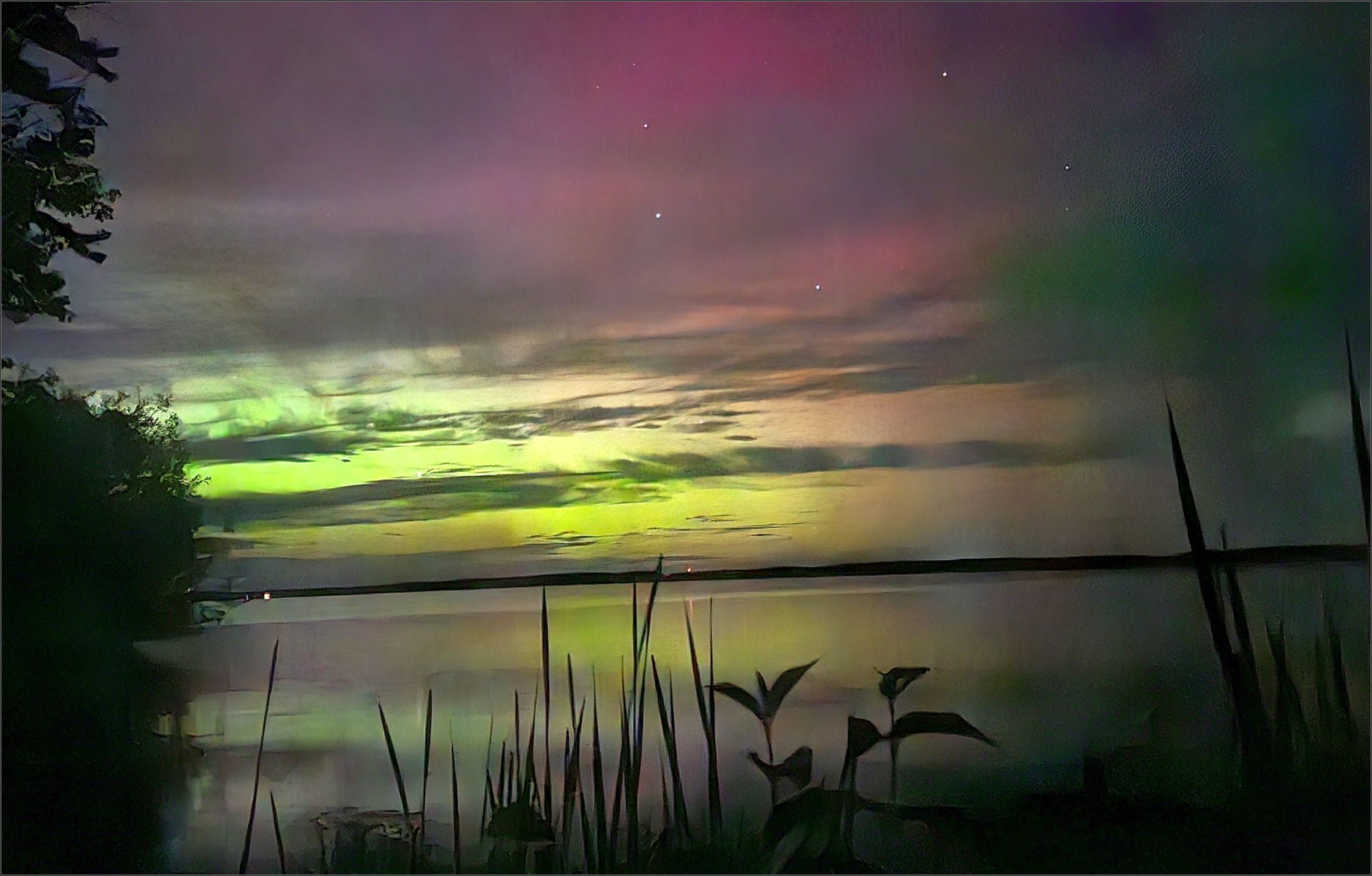
I have always wanted to see the Northern Lights. I was even about to book a trip to the Northern Territories in Canada, where the Aurora can be seen up to 240 days a year. The lights are normally seen above the Arctic circle, but 2024 is here with a series of intense geomagnetic storms, reason the Aurora has also been seen at much more southern latitudes. There is word that the solar activity will peak in 2025, and even in 2026. Southern Ontario was blessed with few shows this year, and there are more to come. We just have to look up!
Tip(s) of the day:
- Search for a safe dark area, with little or no light pollution;
- Get a tripod for your camera;
- Learn how to photograph the aurora with your device; If you are a newbie like me, you can use the night mode of your cell phone (if it allows) or you can play with the pro-mode;
- Let your eyes get used with the darkness. If you have a light, turn it off, and also turn off your camera/cell phone. If Aurora is not strong enough, you might see whitish area;
- And yes, these are Northern lights, remember to look up North – Big Dipper can be your reference (although, when Aurora is very strong, it can be seen above your head, or even southward).
~ pictures taken on August 11, 2024
p.s. As per Space.com: “In the early morning hours today (Aug. 14 – 2024), the sun unleashed the most powerful class of solar flare, in a potent X-class eruption. The solar flare peaked at 2:40 a.m. EDT (0640 GMT) and caused shortwave radio blackouts over the sunlit portion of Earth at the time of the eruption, Asia and the Indian Ocean.”
This could mean a lot, but if you are up to see an Aurora, this coming weekend might be the time.
 1000 Places and Memories
Great photos and information, Christie. Unfortunately, I’ve been in several places where they have been seen this year. Unfortunately, I’ve been there at the wrong time. Thanks!
LikeLiked by 1 person
I hear you! We were also having rain and/or cloudy skies most of the nights when Aurora was active. As you can see from the pictures, the clouds were fast approaching that night, too😀
LikeLiked by 1 person
Amazing colours
LikeLiked by 1 person
Thank you!
LikeLiked by 1 person
Beautiful! I can’t believe they can be seen so far south this year!
LikeLiked by 1 person
We are getting closer to the peak of the Solar cycle 25, meaning there is an increased solar activity these years. Luckily the clouds cooperated and let me snap some photos before covering totally the sky🙂
LikeLiked by 1 person
Wow, how wonderful.
LikeLiked by 1 person
Thank you, Peggy!
LikeLiked by 1 person
Stunning captures of the northern lights! I can’t believe you managed to see them in southern Ontario!
LikeLiked by 1 person
There were few good days this year, in May, June and August when Aurora was observed. We might also have good opportunities this coming Friday.
LikeLiked by 1 person
That was very interesting information. Being from Sweden it was especially interesting to read about what the Sami and the Vikings thought about it. I’ve seen aurora borealis many times in northern Sweden, some really spectacular ones. But never here in Texas for understandable reasons. Your photos are gorgeous.
LikeLiked by 1 person
How lucky of you to see the majestic dance of the beautiful Lady🥰
The Northern Lights have been on my bucket list for a long time, and I never thought I could see them from here. I find them fascinating, and I really hope seeing them again.
Texas is a bit too far for sure, but if you want to see them some day, again, you can visit anytime your home country unless you choose Canada🙂
Have a wonderful day!
Christie
LikeLiked by 1 person
Thank you Christie. You are so right. Have a wonderful day you too.
LikeLiked by 1 person
It’s my dream to see the Aurora Borealis with my own eyes. So fortunate you get to see them close to home. Thanks for sharing, Christie!
LikeLiked by 1 person
I was so lucky indeed, as most of the time when Aurora was active in the past couple of years, we’ve had rain or cloudy skies😀
Hope you will be able to see the Northern lights too, the scientists predict a high solar activity until 2026.
Have a lovely day! xx
LikeLiked by 1 person
Spectacular! Those colours are magnificent. Thanks for sharing. Mel
LikeLiked by 1 person
Thank you Mel🥰
LikeLiked by 1 person
It’s amazing how nature can offer such breathtaking beauty, and you’ve captured that sense of wonder so perfectly.
LikeLiked by 1 person
Thank you so much for stopping by, and have a wonderful day🙂
LikeLike
What a dream. I hope you’re having a great time!
LikeLiked by 1 person
Yes, I was thrilled I could finally capture the moment🥰
Thank you!!
LikeLike
How wonderful to see the aurora so vivid and bright right where you live! It was visible in London earlier this year but we missed it as we hadn’t bothered looking out, assuming in our suburb the light pollution would be too much. It wasn’t, and some people got pretty good images, so we were kicking ourselves!
LikeLiked by 1 person
I think I know what you’re talking about.. it was back in May, we also had a great show that night. Which I missed it too, as we got late in the city, and too tired to get outside..
But I’m sure that more opportunities will come your way!
xx
LikeLiked by 1 person
That is an amazing view.
LikeLiked by 1 person
Thank you!!
LikeLiked by 1 person
You’re welcome Christie
LikeLiked by 1 person
You were lucky to see them and take gorgeous photos.
We attended a little science lecture about aurora borealis when visiting the observatory near where we live. It was so fascinating. Unfortunately we haven’t had the opportunity to see any so far. Hopefully one day 🤞.
LikeLiked by 1 person
It is actually so interesting to learn little facts about aurora, isn’t it? Hope you can see it one day with your own eyes too🙂
LikeLiked by 1 person
Lucky you, Christie, bring able to see the Aurora at home instead of having to travel a long distance and incurring a significant cost, too! I’ve long thought about heading to Iceland in winter in the hope of seeing one. Guess I’ll just let your photos give me my Aurora fix until then!
LikeLiked by 1 person
I’ve heard that Iceland can be really expensive during the winter time, and I was thinking more at Yellowknife as an option. I can push it down to the bottom of the bucket list now😍
Have a lovely week! xx
LikeLiked by 1 person
Fabulous photos Christie! Sadly, I missed the lights when in Toronto this year as it was grey and overcast. Aurora is my sister’s name so it’s special in many ways. 🙂
LikeLiked by 1 person
Southern Ontario was covered with clouds and rain most of the time when we had a chance to see Aurora, in the past 2 years🤣 Luckily this time it was partially clouded, and I got outside right in time!!
It is a beautiful name, xx
LikeLiked by 1 person
Would love to see that and yes, it’s a beautiful name.;-) x
LikeLiked by 1 person
So many beautiful and colourful photos! I have long harboured a wish to see the northern lights because it is surely one of the most, if not THE most, spectacular events in nature. Much to my delight, I never needed to travel above the Arctic Circle when there are long periods of darkness, because over the last few years, Aurora made countless appearances right here in Sligo and we were all able to witness its splendid beauty. Thanks for sharing, and have a good day 🙂 Aiva xx
LikeLiked by 1 person
So glad you didn’t need to travel long distances to witness such amazing event. It is said that 2024 and 2025 are great years to see Aurora from lower latitudes, so there are more opportunities our way🙂
Have a lovely evening!
xx
LikeLiked by 1 person
🥰🥰🥰
LikeLiked by 1 person
These photos are stunning! Somehow I always seem to miss the Northern Lights, even as they have been visible further south at times these days. I’ll keep looking though!
LikeLiked by 1 person
I missed so many of them too! Nature is amazing, keep looking for them!!🥰
LikeLiked by 1 person
Gorgeous!!! Lucky you, to have been able to see the Northern Lights and take such wonderful pictures. We hope to see some Northern Lights when we’ll be travelling along the Norwegian coast up to and beyond the North Cape in January next year.
LikeLiked by 1 person
There were actually several (and better) opportunities to see the Northern Lights this year, in southern Ontario, but I was elsewhere almost all the time LOL
From what I understand, we will still have many chances throughout 2025. Hope you’ll be able to see them too!
LikeLiked by 1 person
You are very privileged to see the Aurora Borealis – it’s breathtakingly beautiful. Stunning photos of this phenomenon.
LikeLiked by 1 person
Thank you Corna! I’ve been so lucky that night, to be there, just in time before the clouds moved in to cover the sky. Hopefully we will have some other opportunities to watch the Northern Lights, the most important thing is to be in the right spot at the right time🥰
LikeLiked by 1 person