
Perched along the north bank of the Douro River, Porto is best known for its Port wine, but also for its historic centre, which has been designated a UNESCO World Heritage since 1996.
Porto (also known as Oporto) was called Portus Cale in Roman times, which eventually gave the city its name. An important trading port and commercial site, Porto was targeted by many tribes and powerful forces over the centuries, including the Visigoths and the Moors. The kingdom of Portugal expanded between the 12th and the 14th centuries through what was called the Portuguese Reconquista, a Christian reconquest after more than 700 years of Muslim rule in the Iberian Peninsula. As new shipyards contributed to the city and country development, Porto became more and more famous. In 1415, Price Henry the Navigator embarked on the conquest of the Moorish port of Ceuta, in northern Morocco, followed shortly by sponsoring maritime expeditions, initiating the Portuguese Age of Discovery.

We spent two days in Porto and enjoyed the city at a relaxed pace, which we highly recommend, if you decide to visit this city. You can explore the charming streets and neighborhoods, visit top museums and cultural attractions, take a tour, or sample local food and wines. We found the city easy to navigate and very walkable, despite few strenuous walks and stairs to climb. These are our discoveries😊
Cais da Ribeira
Our first stop in the city was at the Miradouro da Serra do Pilar. This is actually in Vila Nova de Gaia, across the river, and offers a breathtaking view of the Cais da Ribeira, Douro River, Dom Luis I Bridge, and all the coloured and red-roofed houses cascading down the steep slope above the river.

Cais da Ribeira is the riverside area that runs along the Douro River and is part of Porto’s historic heart. Beyond the touristy first impression, this bustling commercial area is still worth a stroll as you head from Praca de Ribeira to the Dom Luis I Bridge. Even if the crowd may not be your favourite, there is still so much to appreciate in this area, especially the beautiful River Douro and the pastel-colored buildings along its banks. You can also enjoy the various singers and performers, some roasted chestnuts, or simply a coffee at one of the terraces along the river.

***
Dom Luis I Bridge and Douro River
The iconic Dom Luis I Bridge inaugurated on October 31st 1886 was designed by Teofilo Seyrig, a student of Gustave Eiffel. This double decker bridge is supported by a great iron arch and five piers with a span around 391.25 m. Linking Porto to Gaia, the bridge sidewalks on both decks offer pedestrians great views of both banks of the river.
Since the Douro River crosses two the most populated municipalities of the district, we noticed quite several bridges around. If you want to see all six bridges in Porto, you can opt for one of the many river cruises. We preferred to relax on one of the many café terraces instead and take in the energy of the place.

Read more : Aix-En-Provence, the city of a thousand fountains
***
Sao Bento Railway Station
If you happen to pass by Sao Bento Railway Station, then you must enter the large atrium and take a look at the fantastic azulejos. With a design influenced by French Beau-Arts architecture, the station was built in the early 1900 on the site of the Benedictine Convent of Sao Bento.
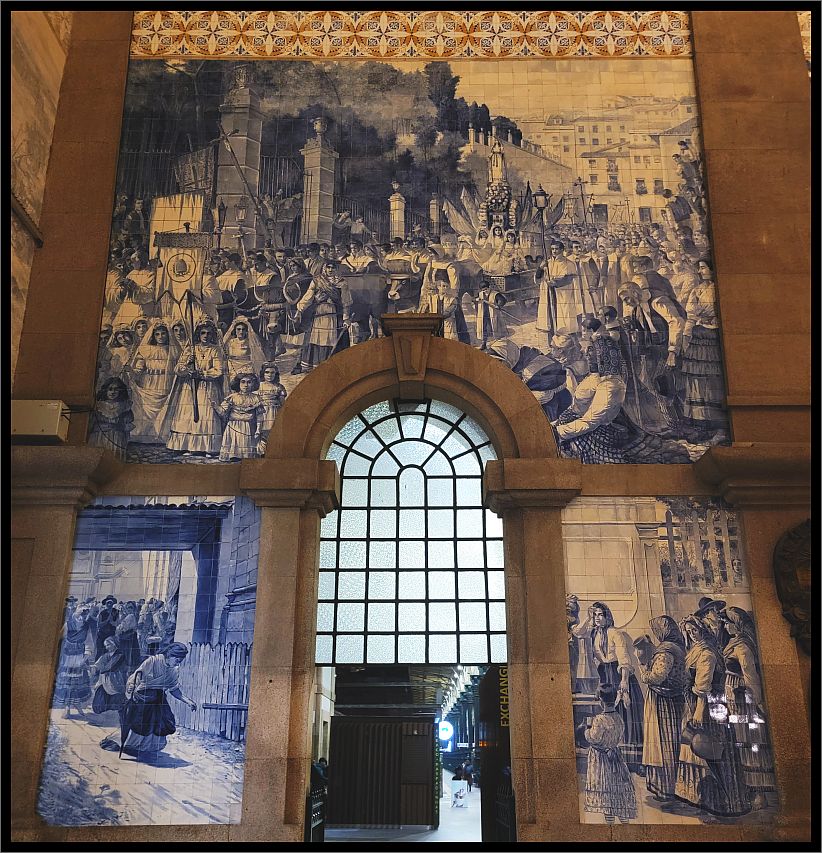
If you like azulejos, then you may have heard of these approximatively 20,000 tiles covering the large vestibule of the rail station. If you don’t know about them, I’m pretty sure you will want to find out what they are. Coming from the Arabic word al-zulayj, “little stone”, these Portuguese tiles that were initially used in religious architecture, then on the facades of private buildings, over time became famous and accepted throughout the world as decorative tiles.
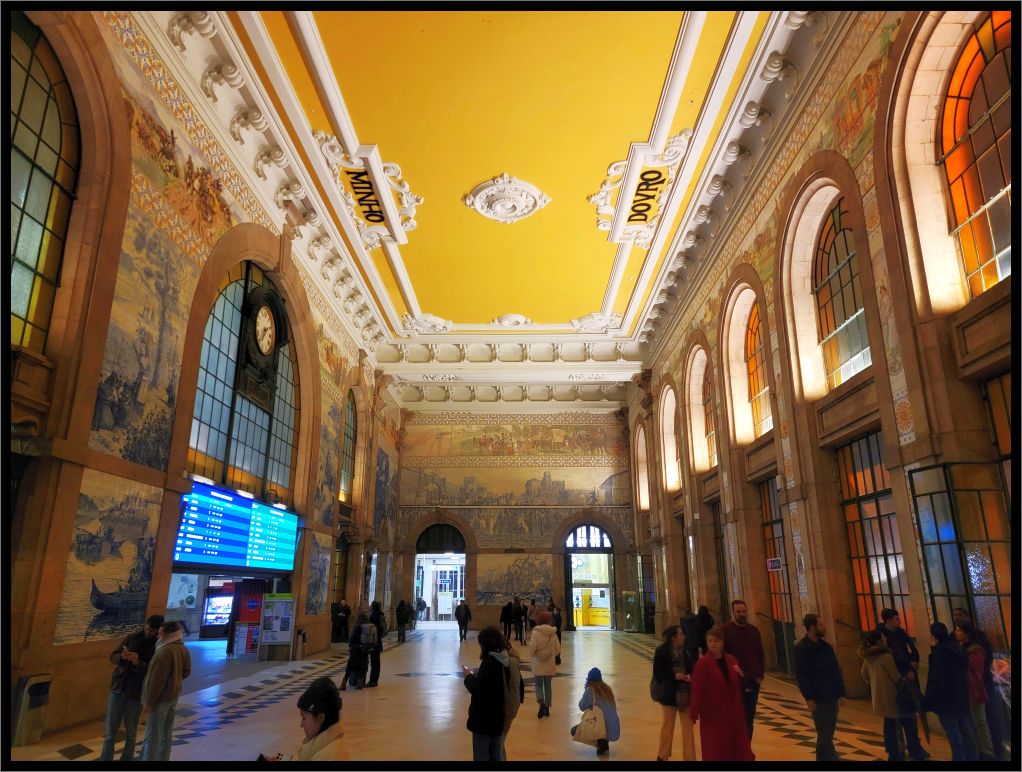
Several scenes and compositions depicting historical events from Portuguese history caught our attention. The tiling project took 11 years to complete, from 1905 to 1916, and both blue and polychromatic azulejos kept us mesmerized for awhile around the room.
*Free entrance
***
Livraria Lello
Founded in 1869 by Frenchman Ernesto Chardron, this bookstore is the oldest one in Porto. Later, in 1906 it became the Livraria Lello, which is what it is today.
I was hesitant to enter the bookstore when I saw the long queue at the entrance. Tickets were sold online only and we had to select a slot time. I’m pretty sure the owners don’t really need to sell books if they charge €10 pp just for visiting. But then we thought it could be a once in a lifetime thing, so why not?! We enjoyed the live music while waiting for our turn, wondering if the bookstore was overrated.
But then we walked in and were taken by surprise. The first thing we saw was the beautifully carved, forked staircase that looked like it came straight out of a fairytale. The forked staircase joins again after a twist, leading to a suspended path that connects both sides of the store on the second floor.
The wooden ceiling of the first floor stands out with its detailed carvings, while the stained-glass ceiling on the second floor adds more distinction. Both floors’ bookshelves are filled with books, and some people were actually browsing.
We found the place far too busy and at one point I was even wondering if the wooden structure would hold all of us. It did😊
*Entrance fee is €10 to visit the bookstore. The voucher can be redeemed if you purchase a book

Read more: Vienna vs Budapest
***
Churches of Porto
Igreja do Carmo
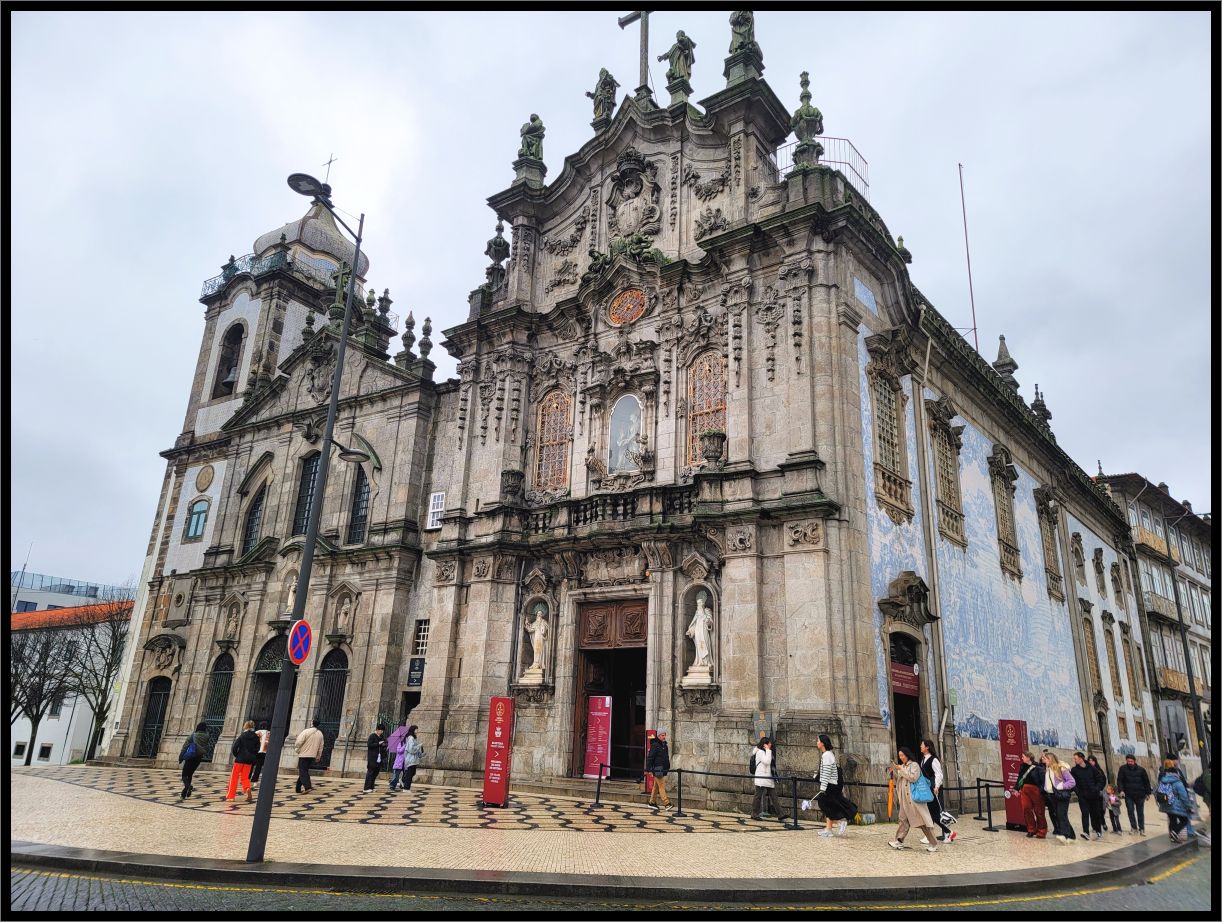
Impressed by the beautiful blue azulejos on the church’s southern exterior wall and the fine intricacies on the façade, we decided to try and see what this church looked like inside.
With a gilded altar, very similar with the one at the cathedral, we made the tour to the hidden house, built between the Church of Carmo, and the Church of Carmelitas which is right next door. The hidden house is known as the narrowest house in the city, with no more than a small room on each floor.
With a small adjacent room for a catacomb, and few more rooms with artefacts, this 18th century church dedicated to Saint Anne made a nice quick stop.
*Entrance fee is €5, for the museum, catacombs, rooftop as well as the Hidden House.
***
Igreja de Santo Ildefonso
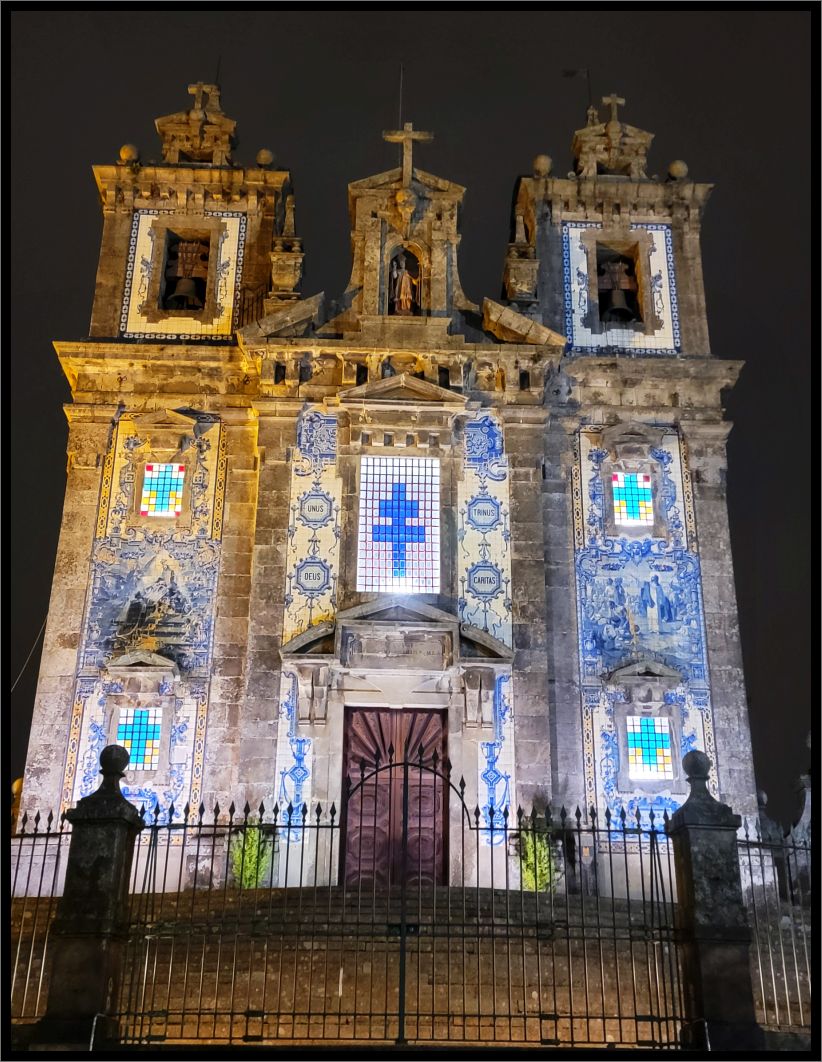
We were lucky to pass this church twice a day, as our accommodation was in the same neighbourhood. Situated on top of a small hill, I found the church quite impressive, day or night.
Built in the first half of the 18th century on the site of a medieval hermitage, the church had its exterior tiles added at a later date in 1932. The blue azulejos depicting scenes from Jesus’s life captured our attentions right away. They are in good shape, contrasting with the mould-blackened concrete walls.
*Free entrance
***
Se Cathedral do Porto
Standing out on the hilltop, overlooking the Douro River, Porto Cathedral might catch your eye right away. Originally built in the 12th century and expanded in the 13th century in Gothic style, it didn’t reach its current state until much later in the 17th and 18th centuries, when the exterior and interior look of the cathedral was changed into Baroque style.
Both the inner courtyard and the exterior of the church look quite plain. We were instead impressed by the interior decorations, the towers, the cloisters and the beautiful azulejos depicting various scenes that adorn the walls around the cathedral. If you have a chance to visit the cathedral, don’t forget to climb the tower, you will be rewarded with a beautiful view of the city below, the river, the bridges, and even a section of the medieval Fernandine walls.
*Entrance fee is €3 to visit the museum, the cloisters and get to the tower.

***
Igreja dos Clerigos
If you don’t have time to visit all the churches in Porto, then you should consider Clerigos Church. This Baroque church with a marble altarpiece and a 75 m bell tower is a symbol of the city of Porto, reason why it was classified as a UNESCO World Heritage Site.

The history of the Brotherhood of Clerigos began in 1642, when the Brotherhood of Poor Clerics was set up in Porto. But nothing is poor when you talk about the architectural complex of the church and the tower. Built in the 18th century under Nicolau Nasoni supervision, the construction was later classified as a National Monument. In 2014 the complex was restored, and 13 km of electric wires were installed, 60 kg of cotton, and 140,000 sheets of gold leaves were used. Now, the church offers various combination of tickets for those who want to see multimedia shows in addition to the standard tower, church and museum tour. We opted to climb to the top of the tower and despite the gloominess and morning drizzle, we still had a great time. The tour took us through the museum, sacristy and several rooms from the upper level giving us great vantage points to see the nave from above and all the adorning statues guarding the altar nearby.
As a bonus, the concert from 12 o’clock took us by surprise, what a great timing for us!
*There is no admission fee to enter the Church and there is a daily pipe organ concert at 12 noon too. Entrance fee to the Tower is €10, and the tour takes you to the museum as well. You can check here for other type of combo tickets .

Read more: Marseille, the city of 100 neighbourhoods
***
Museums
Casa do Infante
Built in 1325, Casa do Infante is named after Henrique, the Navigator. The building is one of the oldest buildings in Porto. This national monument has served different purposes over the centuries, as a residence and warehouse of the royal family, as the old Customs house and the Royal Mint. After excavations and restoration in the 1990s, Roman and Middle Age remains were discovered.
The building is named after Henrique the Navigator (Infante Dom Henrique), because in the early days of exploration, he sponsored maritime expeditions of such importance that he has been considered the real and symbolic key figure of the Portuguese voyages of discovery. Not much to see inside, but we learned more about the Portuguese history.
*Free entry on Sunday, otherwise €4 pp.
Palacio da Bolsa
The Palacio da Bolsa, today the Chamber of Commerce, is a neoclassical building, built between 1842 and 1850. The exquisite interior work began later in 1860, and was considered completed in 1909, shortly before the proclamation of the Republic.
The Arab Hall, the jewel of the Palace, was inaugurated in 1880, and it took 18 years to complete. We also liked the Courtyard of Nations, the large hall located right at the entrance, the Noble Staircase, and the General Assembly Room.
*The Entrance fee is €14, and the mandatory guided tour lasts about 30 minutes, four languages available.
Read more: The ultimate guide to visiting Palácio da Bolsa

***
Porto on foot
The centre of Porto is relatively compact, and the walking distance from one landmark to another is no more than 15-20 minutes, so if you are wondering if Porto is a walkable city, my answer would be yes.
Exploring a city on foot is absolutely my favourite activity. We always like to walk aimlessly in a new city once we visit the most important landmarks and points of interest, to get to know different aspects and what better way to know a city than to explore it on foot. Porto central area is quite charismatic, easy going, despite all the alleys going up and down. And a LOT of stairs.
Not only the heritage monuments contribute to the city’s personality, but also the cobblestone alleys or the random street art, the statues and the colourful buildings around the city. A city of contrasts, we also found dilapidated buildings, moldy ramparts, and dark walls that were in dire need of renovation. Some of them showed signs of being upgraded, but some others looked abandoned. I really hope someone starts reconditioning them soon, as it would be a shame to lose such a great heritage.
Theoretically you can visit the main landmarks of Porto in one full day, but you really need two days to take in slowly all the sites, and get a chance to try some good food and sample some Port wine.
Read more: How to spend a week in Madeira


***
Tip(s) of the day:
* You can get in Porto by air, road or train. If you prefer to drive a car, be ready to pay the tolls for the national highways. You can pay by cash, credit card, or automatically using the Via Verde transponder;
*If you chose to drive in Porto, be aware of the limited traffic zones in central areas, find a convenient parking lot prior arriving in the city, as many streets are narrow, under construction, or very busy;
* The city is located across a high bank of the river, which implies a lot of uphill and downhill, stairs and steep alleys and streets – get ready for some good walking;
*We visited Porto in February, which is considered the off-season. Weather wise, it was cloudy most of our time in Porto, but we enjoyed the lack of seasonal crowds.
~ visited in February 2025
 1000 Places and Memories
Truly a magical place Christie. That library has a lot of character. We have never been to Portugal. Thanks for sharing. Allan
LikeLiked by 1 person
We loved Portugal, both the cities and the coastal trails we visited. One never gets bored there! Happy Friday🥰
LikeLiked by 1 person
We visited a couple of years ago and found we could see everything we wanted to see in two days and on foot.
LikeLiked by 1 person
Glad you found Porto walkable, too. Have a beautiful weekend!
LikeLiked by 1 person
Thanks and you too Christie
LikeLiked by 1 person
Thanks for the return visit to Porto today Christie. It sounds like you enjoyed it as much as I did. 😊 Maggie
LikeLiked by 1 person
Yes, we enjoyed Porto very much. We have not visited so many churches and museums in a looong time😍, but it was very interesting to see the architectural styles and to learn more about the local history.
Have a nice weekend! xx
LikeLiked by 1 person
It’s always nice to return to Porto in good company, Christie. My son is heading there for his wedding anniversary later this year xx
LikeLiked by 1 person
Always glad to see good company here😊
I think it’s a great place for them to have a good celebration, enjoying delicious food and drinks. Happy early Anniversary to them❤️
xx
LikeLike
Thanks xx
LikeLiked by 1 person
I really did mean to include this in my Monday walks this week, Christie, but it slipped the net. We have many of the same readers but I’ll put it in for next week xx
LikeLiked by 1 person
Thank you so much, but no worries Jo. There will be a few more posts about Portugal hopefully soon😍
LikeLiked by 1 person
I enjoyed visiting Porto; sounds like you did, too. Cheers.
LikeLiked by 1 person
Yes, we did have a great time! Glad you liked it too😊
LikeLiked by 1 person
Fabulous. Porto has been on our wish list since the wish list was born. And yet we still haven’t made it somehow! Every time I read posts like this it makes me regret that we’ve not made it yet.
LikeLiked by 1 person
One country at a time😊
Thank you!!
LikeLiked by 1 person
I am not a cities person, but Porto is a favourite! Thanks for the memories. Mel
LikeLiked by 1 person
Glad I could bring you nice memories🥰
We also loved Portugal coastal trails, they are stunning; there is a nice balance in Portugal between indoor and outdoor activities, don’t you think?
xx
LikeLiked by 1 person
Yes, I loved the history and all the fabulous tile work on display in the buildings. I was walking the camino there, so definitely enjoyed the outdoors too. Have a great day. Mel
LikeLiked by 1 person
So many beautiful photos from one of my favourite cities! From the waterfront bars and restaurants of the Ribeira district to the funky shops and cafés of Cedofeita, Porto is a blend of timeless elegance, remarkable architecture and a culture that is warm and welcoming. Just last week I actually booked flights from Dublin to Porto and can’t wait to explore the city once more. Thanks for sharing, and Happy St. Patrick’s Day 🙂 Aiva xx
LikeLiked by 1 person
So nice to have a chance to explore again this lovely city! Enjoy your vacation🥰
Hope all is well Aiva!
xx
LikeLike
Thanks, Christie, for reminding me what a lovely city Porto is through your excellent text and photos. We were there several years ago and it was one of the reasons we fell in love with Portugal and would love to return for a much longer stay and exploration. The azuelos are to die for, aren’t they?!
LikeLiked by 1 person
I know, right? And they are everywhere!!
🥰
LikeLiked by 1 person
“The tiling project took 11 years to complete, from 1905 to 1916,” Wow! What a detailed intro tp Porto, Christie. Lots to see and think about, but my favorite is the book store. Peggy and I love bookstores and we would head there before anywhere else. Thanks much for the tour.
LikeLiked by 1 person
Indeed, there are a few amazing bookstores around the world!
Welcome😊
Happy Wednesday!
LikeLike
Thanks Christie!
LikeLiked by 1 person
I never did get to Porto although I traveled up the coast in Portugal. Perhaps another time… I love the azulejos in the train station and, of course, the classic bookstore – both so stunning!
LikeLiked by 1 person
Because there are so many beautiful places to visit in Portugal, I had a hard time deciding which ones to visit first, too🥰
Have a lovely day!
LikeLiked by 1 person