
Cabo da Roca, the westernmost point of the European continent, is located at the very end of the Sintra Mountains, and is undoubtedly one of the most iconic places in Portugal.
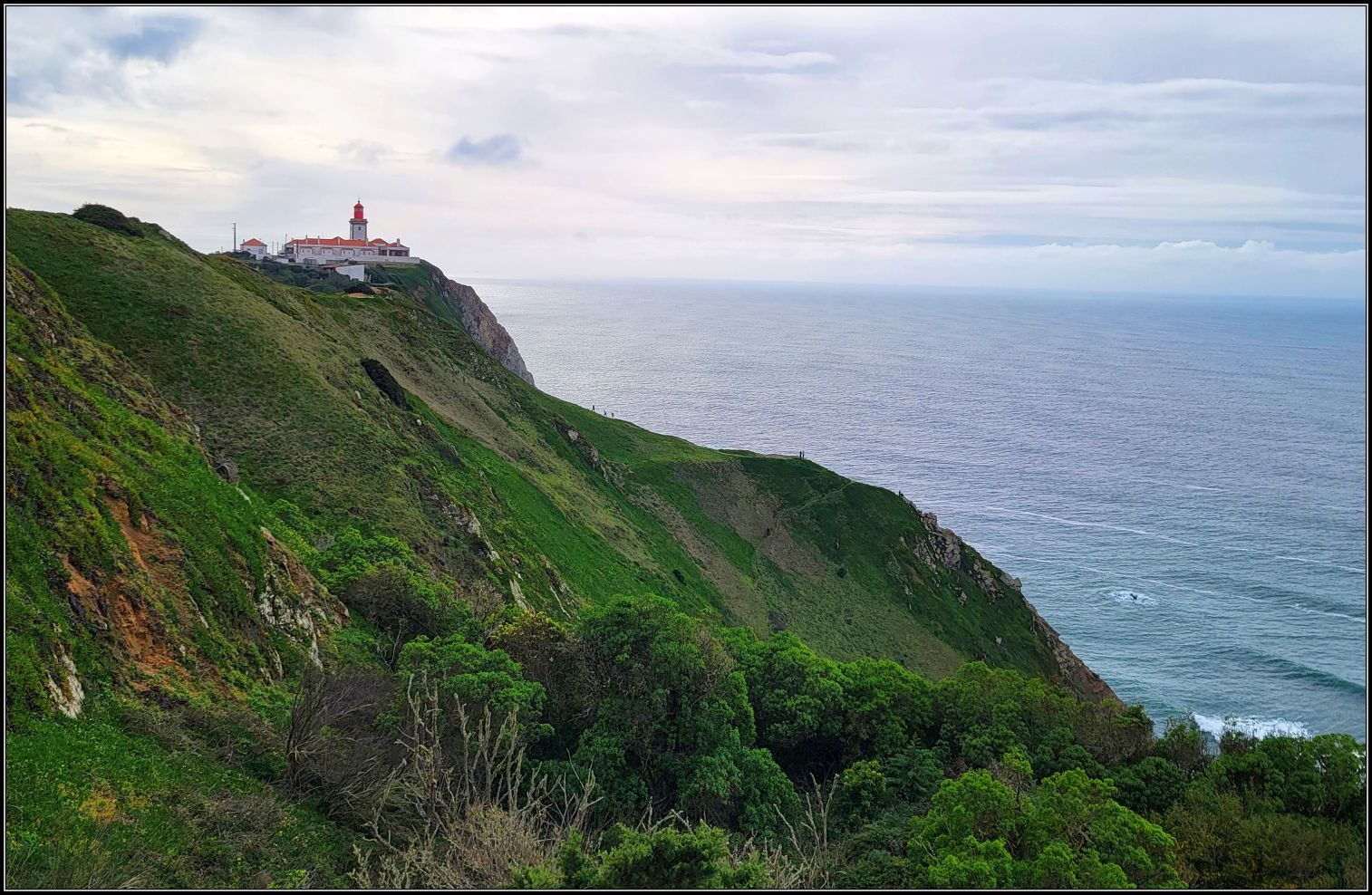
The winding road leading to the end of the world looked idyllic, despite all the narrow sections where my heart skipped a beat or two. As soon as I saw the lighthouse, I knew we’re almost there.
The cape is located 42 km west of Lisbon and is within the Sintra-Cascais Natural Park boundaries. Cabo da Roca has been an important point for sailors, even from Roman times. Here, at 140 metres above the sea you can have a panoramic view over the Serra de Sintra and the entire coast. Reason a lighthouse was built, one of the oldest on the Portuguese coast. Dating from 1772 and automated since 1990, Cabo da Roca lighthouse is still operational today, guarding the entire Atlantic coastline. As the westernmost lighthouse in Europe, it seems to me like a sister to Cape Spear, the easternmost lighthouse in North America, from Newfoundland.
Read more: Exploring Portugal – The walled city of Obidos
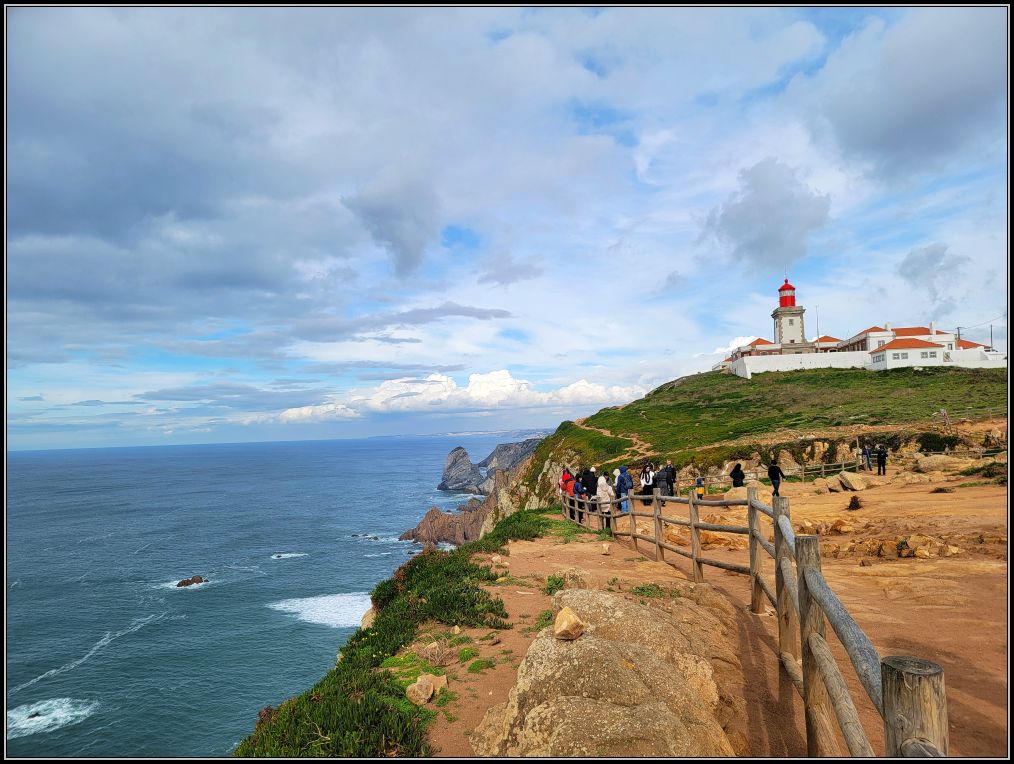
After taking a couple of pictures in the large lot where the stone monument is, we were ready to explore the wild and rugged coastline. A great way to avoid the crowds is to follow PR-7, the Cabo da Roca hike.
There are two hiking options, to follow either the northern or the southern direction. We chose the northern direction, as Praia da Ursa is considered one of the hidden gems of the Serra de Sintra region. Starting from the main road, PR-7 Cabo da Roca is marked with red and white painted markers. The dirt path is very distinct across the vast blanket of ice plants and around clusters of various bushes, you can’t really get lost. The entire circular route is between 8 and 15 km long, depending which trails you take.
Read more: A hike to remember, Pico to Pico

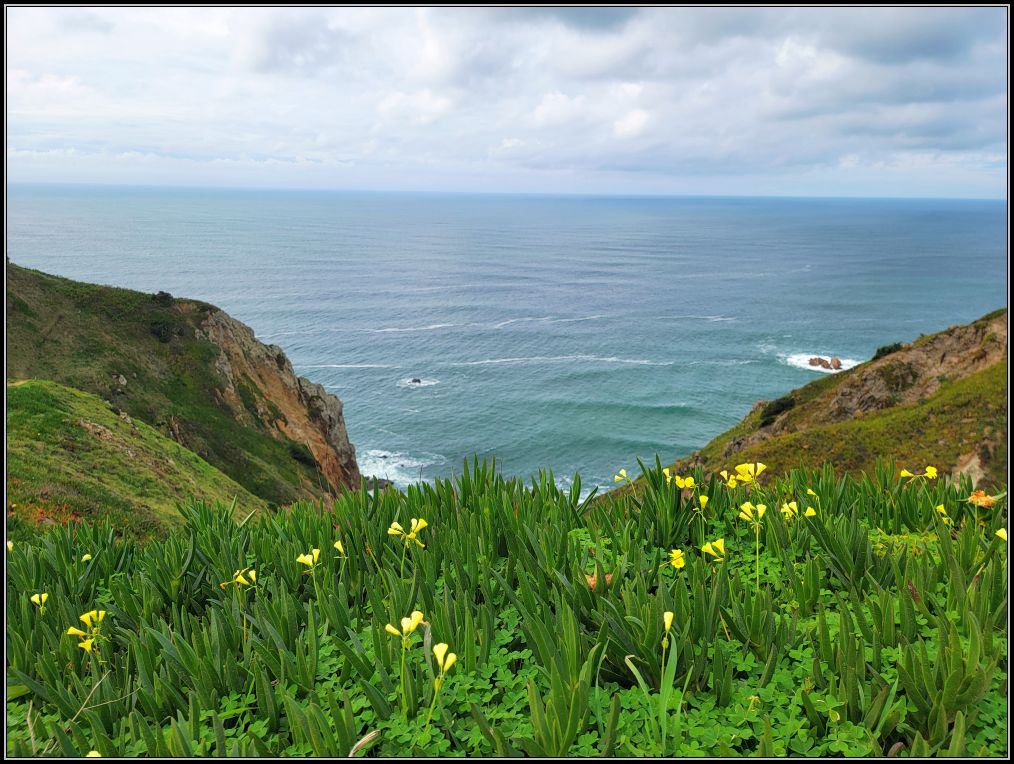
The west cost is renowned for its mix of sandy beaches and rocky cliffs, and the rolling clouds provided an even more dramatic view of the Atlantic Ocean. Walking up and down the hilly terrain required our full attention, as we found the rubbish quite treacherous. Fortunately, the ground was dry, as several sections were quite slippery.
Read more: Strolling through Porto, a walking guide to the most historic landmarks

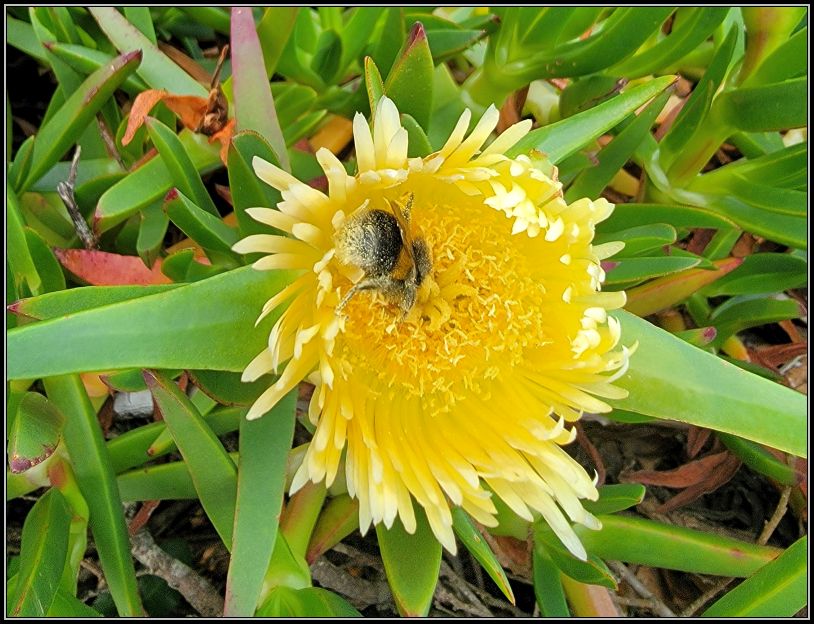
As we moved further away from the lighthouse, we encountered fewer and fewer people, and we had plenty of time to enjoy the dominant fields of Hottentot figs (ice plants) that flourished so well in such windy and harsh conditions on these slopes. The pink and yellow flowers of early spring welcomed the bees and bumble bees, and we took our time to enjoy their buzz.
Soon we approached the sea stacks of Praia da Aroeira, and after a few photos we continued our way.
Read more: Discovering Laurissilva forest: Levada do Caldeirao Verde
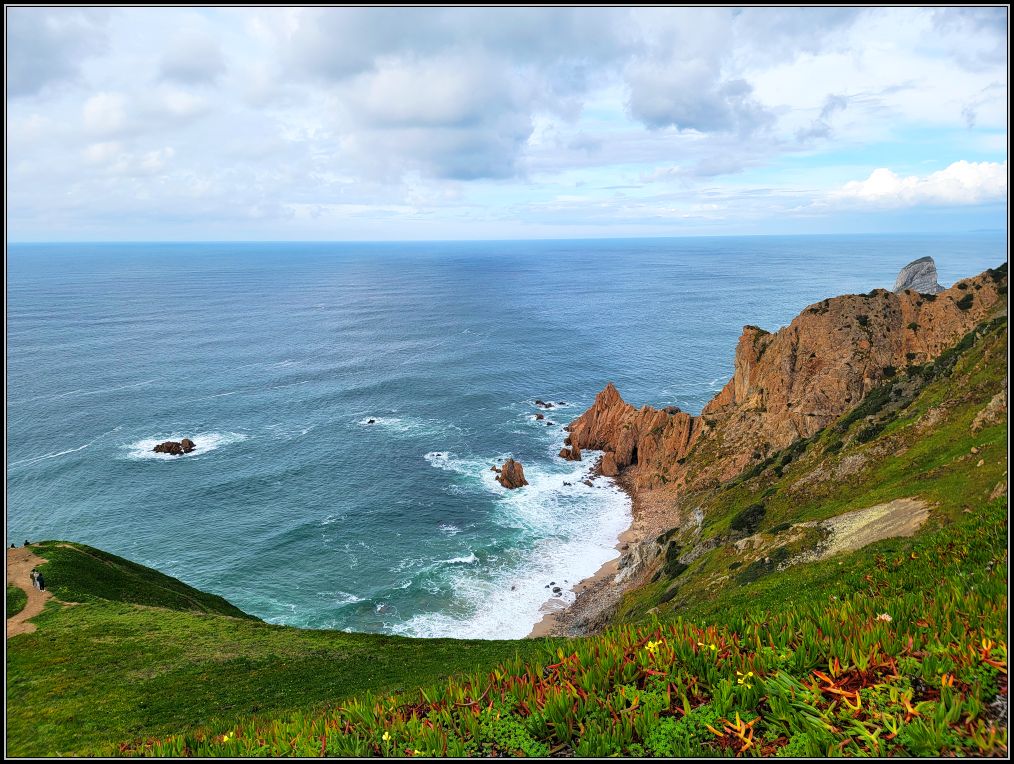
Although Praia da Ursa is only 1 km from the Lighthouse, the strenuous up and down walk makes the trail more difficult, doubling the effort. As soon as we approached the place, we got rewarded with prettier views. Several tall sea stacks guarding the cove allowed the formation of a pristine and solitary beach. The person at the information centre told us that the steep path down to the beach could be very tricky and we didn’t want to risk, so we stayed on the ridge.

With a picturesque natural setting and unique rock formations, Praia da Ursa stands out with its two basalt dikes, reminding me of the even more special geological formations in Madeira, along the Vereda da Ponta de São Lourenço.
Praia da Ursa was a nice stop before we returned to the parking lot. We still had a short drive to our next destination: Sintra.
***
“Onde a terra se acaba e o mar começa” (Where the land ends and the sea begins) – Luís de Camões
***
Tip(s) of the day:
*The easiest way to visit the region is by car or as part of a tour, but it is also possible to travel here by public transportation from Sintra and Cascais;
* There is no parking fee, and it can be crowded in high season;
*The unique microclimate can make it feel cool and windy most of the time, so you need dress accordingly; fog and rain can also be found quite frequent;
*The cliffs around Cabo da Roca are steep, slippery and unstable. Although the trail is not difficult, avoid hiking near the cliffs, or when wet and wear good foot gear;
* Pay washrooms are located at the information centre; it might be useful to have 50 cents cash on you.
~ visited in February 2025
 1000 Places and Memories
Wonderful, Christie! We haven’t done this one but we have Portuguese neighbours with an old house on that coast and they come here May to September to escape the weather. One day we’ll go and see them up there xx
LikeLiked by 1 person
How lovely to have some friends up there. You should visit them soon! 🙂
Cheers, xx
LikeLike
They are quite elderly and we don’t want to cause stress, but I’d love to visit xx
LikeLiked by 1 person
Great-looking hike! You mentioned that it can be cool and windy there; how was the overall temperature in February?
LikeLiked by 1 person
The central and northern part of Portugal had about 15-17 C (60 F), while the sourthen coast was much warmer 21 C ( 70 F). Cabo da Roca was particularly windy, making it cooler. But overall we got a great weather mid-February in Portugal (for hiking and sightseeing); just a bit of rain one night and the following morning while we were in Sintra.
Have a lovely day!🌞
LikeLike
Wow, what a gorgeous hike! I think I could spend all day along that trail just gazing out at the cliffs and the ocean.
LikeLiked by 1 person
Right? Me too🥰 We were very fortunate to be able to hike a few more trails along the Atlantic coast. They are so beautiful!
LikeLiked by 1 person
Cabo da Roca is a beautiful spot isn’t it? Looks like you still had pretty good weather for February. Maggie
LikeLiked by 2 people
Oh yes, indeed, the weather was great overall! It only rained the next night, on our first night in Sintra. The mist and the fog from the following morning made the surrounding forest so magical. Now that I think of, I think we were really lucky😊
xx
LikeLike
We didn’t make it to Cabo da Roca, Christie, but we did explore the coast around Sagres where Prince Henry the Navigator started his journeys. Like you, we found Portugal’s coast quite attractive. In ways, it reminded me of the Pacific Northwest coast. And they certainly have ice plant in common!
LikeLiked by 1 person
Yes indeed, I just noticed that yesterday.. we are in San Francisco these days, btw, and we found few places with ice plants. It seems they thrive in windy and sunny spots.
We are yet to get to Sagres! Too many beautiful places along the Portugal coastline, and so little time..
Have a lovely day Curt!
Christie
LikeLiked by 1 person
Thanks Christie. A trip north or south along the coast is guaranteed to bring a lot more. I’d like to slow
LikeLiked by 1 person
Another fascinating post, Gloria, extolling Portugal’s delights. The coastline looks simply gorgeous, but the coastal hike you took would be too challenging for us these days, alas. Added the link, however, to my ever-expanding Portugal Word document!
LikeLiked by 1 person
Although the trail is not difficult, it has a couple of section that required our attention. You will love it🥰
LikeLiked by 1 person
Oops, I just realized I wrote my sister-in-law’s name instead of yours, Christie. I’m visiting her in Ottawa, so that was why she was on my mind.
LikeLiked by 1 person
No worries Annie! Enjoy your time in Ottawa, I guess you’re spending Easter together.
Our daughter lives in Ottawa too🥰
xoxo
LikeLike
Actually, I came up from Denver to be with one of my four brothers last Friday morning before he died. Ottawa is my hometown. I’ll be back up in two weeks for his Celebration of Life a few days later. Steven and I will meet in Chicago on Friday to celebrate Easter with our daughter and her family. Happy Easter!
LikeLiked by 1 person
So sorry for your loss
xx
LikeLike
Thanks for taking us along on this stunningly beautiful hike at Cabo da Roca, Christie. I enjoyed your narrative and the photos are marvelous. I always like the end-of-the-earth places and it’s wonderful knowing sailors as far back as Roman times were out here.
LikeLiked by 1 person
Thank you for coming along! Indeed, these type of end-of-the-earth places are unique in their own way.
Happy Tuesday🥰
LikeLiked by 1 person
Beautiful place to hike ! Well shared with beautiful photos
LikeLiked by 1 person
Thank you so much!
LikeLiked by 1 person
https://notionpress.com/write_contest/details/1559/ashalata. Hi I have taken part in a short story competition please support me with 50 points through the link. Thank you 😊🙏
LikeLiked by 1 person
I’ve been to Cabo da Roca many times and always loved its rugged coastline adorned with rocky cliffs overlooking the roaring Atlantic Ocean. The lighthouse is wonderful, and its secluded location does make you feel like being at “the edge of the world”. Thanks for sharing, and have a wonderful day 🙂 Aiva xx
LikeLiked by 1 person
And you’re actually at the edge of the world, if you consider that not too many hundreds of years ago, people believed that the Earth was flat and nothing more beyond that point..😊
xx
LikeLiked by 1 person
🥰🥰🥰
LikeLiked by 1 person
I had the chance to hike the Cabo da Roca – Praia da Ursa trail a few months ago, and it was truly one of the most rewarding experiences I have had. Thanks for bringing back the memories, I really appreciate you sharing this!
LikeLiked by 1 person
I’m so glad I could bring you back nice memories. We loved Portugal, and especially the coastal trails.
Have a wonderful day!
LikeLiked by 1 person